The Raven and the Coal Mine

Memories of a week spent squatting land scheduled to be Britain’s first new coal mine for decades. First published by https://mckenzieriver.org

A solitary raven has flown over my tent every morning this week. Most days I have heard the prrr-ruk call before seeing the bird’s silhouette, with its fingered wings and wedge-shaped tail. Below the raven, my green tent nestles on waste ground between a housing estate and red-brown rocks that tumble down the sea. This week I am one of maybe two hundred environmental activists squatting land where England’s newest coal mine for decades is planned. A selection of banners, reading ‘leave it in the ground’ and ‘no new fossil fuels’, hang from the edges of our marquees, from the outdoor kitchen and the portable, composting toilets we have erected.

When I arrived, I was warned not to eat the blackberries that grow across the site. Underneath us are the foundations of a chemical works and years of landfill, covered over with concrete and topsoil. The brambles look innocent enough, scrambling across the broken tarmac and cement, but the plants can reach their roots deep down into whatever lies beneath us and draw up the long-buried toxins. Above ground, the tangled stems mingle with low bushes of goat willow, thistle-like flowers of knapweed, drifts of white yarrow, purple selfheal, zig-zag clover, feral sedums and garden mint that scents the air. A comma, orange wings against the green plants, is one of the last of this summer’s butterflies and searches for nectar among the flowers. Someone tells me there are adders here and at night I hear tawny owls calling across the derelict ground.

The land is supposed to be private, but the fencing has been ripped open or rusted into holes and the remains of gate hinges swing empty on their posts. In the evenings, local men and occasionally women walk their dogs among the bushes. Those who stop to chat are friendly, but say that the nearby town of Whitehaven needs the five hundred or so jobs that the coal mine will bring. On the main street there are boarded up shops and, mounted on a plinth like a memorial, an old wheel from the Haig colliery tower. When it closed in 1986, three and a half thousand jobs were shut down with it. I tell the men I understand and that I grew up in mining communities in the English Midlands. As we talk I remember how fifty or more riot vans at a time would line up on our village street on their way to the picket lines. The men of my mum’s family had been miners, I say, with blue-black grit engrained in the scars on their hands. Mum spoke of ancestors killed in underground fires and the dark coal dust her Grampa coughed up in his old age. During the Strike, boxes of food and children’s clothing would be piled on our kitchen floor on the way to the Miner’s Welfare. I left home a year later, returning to see poverty creeping into the villages and towns, shutting down the shops and changing the way people walked. Unemployment has a listless shuffle, mingled with a kicking rage. My conversations with the dog walkers end with agreements, usually as I bend to gently tug a dog’s soft ear – yes, there should have been investment into these communities decades ago and, yes again, the current government is a shambles. I am trying to build bridges with the community that we have set up camp in, so I don’t mention what I am thinking. In a time of rising temperatures and seas, with accelerating rates of extinction, our current worries might soon be completely eclipsed.

One afternoon there is a presentation about the proposed pit. The speakers are in a white marquee and we sit around them on the ground. There is a long discussion on how extracting this coal will ruin Britain’s commitments on carbon reduction and how the site will be fully automated, with no men underground, just machines, boring away beneath the sea bed. The world has moved on since the Haig pit was closed. The old days of the rattling winding gear and the pit-head camaraderie are just memories now and will never come back. When I left the marquee, a warm smell of spices drifted across the camp. The evening meal would be served soon and already people were gathering with bowls and spoons in their hands. I wandered off, looking across the low bushes, grassland and decaying tarmac towards the sea. In this moment, I felt a sudden sadness for this unkempt place, where the wildness is creeping in and local people walk. The speakers in the marquee had said that the toxic waste and soil below our feet would be excavated and taken somewhere (no one is sure where), to make room for the buildings, haulage roads and machines of the colliery. The willows, flowers and brambles would be rooted up, the bees and the butterflies, adders and tawny owls chased away by the noise and construction work, all inconsequential in the face of trade deals and global markets. It feels to me like a kind of madness has gripped those of my species who think that any of this makes sense.

Standing on the cliff above the sea, I watch the glinting wings of goldfinches and the dip and rise of the murmuration of starlings that gathers here at dusk. I have spent some of the last thirty years of my life blockading bulldozers and squatting houses or trees in the path of road building, quarries or airports. Yet I still have no real answers to the seemingly impossible balance between livelihoods, rising waters and temperatures, and the more than human lives of this Earth. Watching the settling birds, I give myself permission to admit this uncertainty and still be here, witnessing the land, speaking aloud the names of the knapweed and brambles, yarrow and comma, starlings and goldfinches. After three decades, acknowledging these lives sometimes feels like the only thing I know. As I turn and walk back towards the tents, the nearby street lights flick on in a long line. In an hour or so a full moon will rise, a fire will be lit in the heart of the camp and a night of songs and stories will begin. In the last moment before sunset, I hear again the deep, slow call of a raven.

On being asked to write about the future

December 2023

Always, for me, this question makes me think about land. Who owns it, who lives on it, how we listen to the stories it tells. How we stop imposing our own will upon the Earth. I’ll acknowledge this is my own obsession, born of a childhood love of plants, frogs, newts, grass snakes and hares; of a fascination with yellowhammers on the edges of wheat fields and of the shifting seasonal wonder of redwings and swallows. A child, I was drawn to the washed up sadness of starfish and I still search rock pools for anemones, opening their scarlet tentacles at the point where the tides change. Questions about the future make me think of rock and soil, forest, mountain, river and farm. Part of my answer is an understanding that those who control the land govern so many aspects of our lives.

As an ecologist, I have spent years surveying wildlife, reading a place through its plants: nettles and docks tell of rich and once-disturbed soil; harebells, delicate as bees’ wings and the colour of a high, summer sky, speak of dry, sandy soils and maybe, once, grazing by sheep. On mountainsides, bracken and bluebells are the shadows of where woodlands once grew. All of these I map and photograph and note down. Back at my desk, I check what I have found against old maps of tithes and the enclosures of common land. Aerial images taken just after the Second World War show where, not long ago, there were small fields divided by hedges and trees. Now there may be houses or roads and hedgeless acres of crops. Every place has a story and often it is one of loss. A slow, quiet, genocide of the wild.

Set against this past, the future seems straightforward: put back the woods and the hedges and meadows, let the wildness back into rivers and mountains. Return least some of the commons, so that people can supplement their incomes with food or fuel, willows for making baskets, nettle for string or strong, green fabric. Grow food to feed people not profits, without spreading poisons or wastes on the land, in the air and into water. It’s the old dream that William Cobbett wrote of, after his rides across Georgian England. A vision picked up by John Seymour in the 1970s. I bought my copy of his ‘Complete Guide to Self Sufficiency’ in the 1980s, when I was twenty. Friends and I took a train from London to Machynlleth and walked three miles out of town to the Centre for Alternative Technology. I came away thinking of wind turbines and raised vegetable beds, of shared bread and rhubarb wine, horses on the land, hens in the yard and dark soil beneath my nails.

I don’t know how to get there from here. Working for a world with a future has been so much harder than I imagined at twenty. Especially today, writing in a library at dusk, as the festive lights come on beyond the windows. It’s busy out there, despite the rain. All that shopping, I think, and the belief it brings happiness, when it is part of what is killing the lives of this world. This winter, as so often before, I turn in on myself to survive. I have been taking long walks alone in quiet places, avoiding towns and social situations, writing while wrapped in a blanket, hearing the hens calling from my garden. As a friend of mine says ‘that which does not kill you gives you terrible coping mechanisms’.

With thanks to Rebecca Stonehill & Norwich Writer’s Rebel

Extracts from ‘Along the River’

The following extracts are my contribution to a collaborative project that charts the course of the river Wensum as it flows across Norfolk. Writers including Nick Acheson, Caroline Davidson and Jos Phillips contributed work on history, personal memories and nature from the source of the river to its merging with the river Yare east of Norwich. The final piece formed part of a publication sold in aid of the campaign to stop the Norwich Western Link Road. For more on the campaign, visit https://www.stopthewensumlink.co.uk.

All illustrations by Kate Baczkowska

Bintree

A borrowed moment, tucked in between my work and my daughter’s college timetable. Just the two of us today. At seventeen, she has the luminous beauty of youth: dark eyes, a tangle of red hair and a sense of the romantic that makes her say, ‘here. This is where we should stop’.

Here is a strip of grass between the river and a lane so quiet that no traffic will disturb us. Its an adolescent river at this point, not far from its source and in a hurry to be somewhere else. Green streamers of weed move restlessly with the current and yellow water lilies float on the surface – their flowers the only hint of sunshine in an afternoon that smells of soil and grass after rain. Sitting on my coat, I make tea in a flask and we drink it strong and black from tin cups, sharing a tub of sunflower seeds, dried fruit and bitter, dark chocolate.

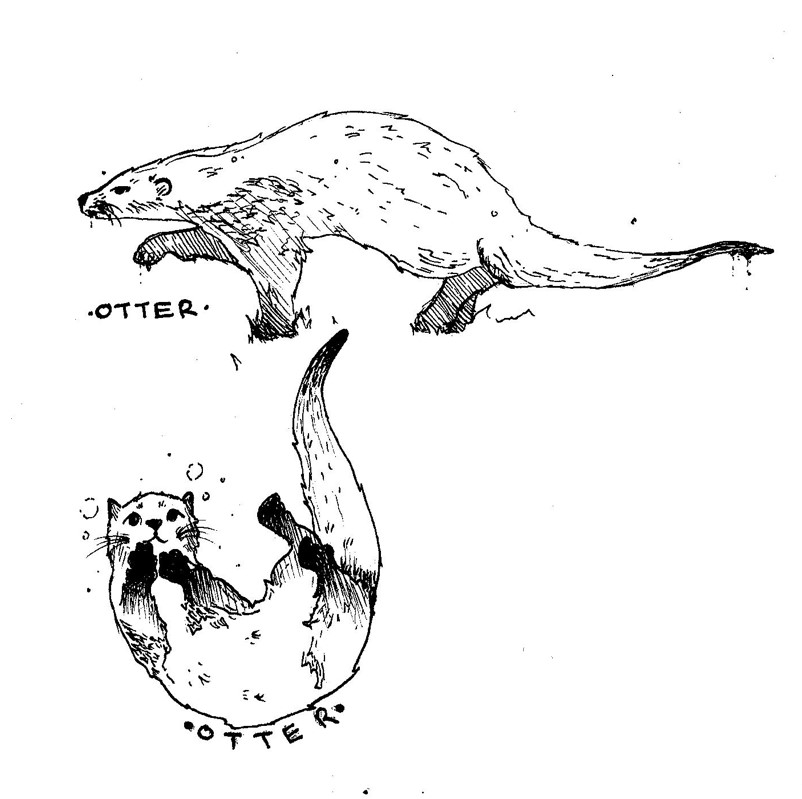
‘Remember the otter?’ Kate asks.

A few months before, we’d been swimming in another Norfolk river and were letting the warm sun dry us as our feet still dangled in the water. A soundless change in the ripples of the river caught our eyes and a large otter came close, trod water for a moment and watched us, quizzical and unafraid.  It left without breaking the surface of the river, more water than muscle and flesh, so at home in its place I was left feeling a splashing and clumsy intruder.

I’m tempted to slip into the cool caress of the river today. It’s not just the cold that stops me. A recent report has shown how England’s rivers are contaminated by sewage and chemicals from farming: the water in front of me looks clear, but what it carries, unseen, is in question.  Once, millennia ago, the people of these islands left offerings of bronze and gold in their rivers, swords and shields and daggers laid in the shallows like a prayer. Now we see them as drains to take what we do not want out to sea as fast as the waters can flow. What will it take, I think as we leave, what will take to once again honour the life and the lives of our rivers? I don’t have a bronze dagger to offer, only a fragile hope that things can change and handful of sunflower seeds. We scatter the seeds on the bank and smile as a robin darts towards them.

Deal Ground

Metal gates, padlocked across a track between empty buildings. Sparse words and a fresh, neon pineapple scribbled on red bricks and boarded up windows. This time, I cannot get in.

Years ago, a council official opened the gates and left me alone to survey the marsh between two rivers: the Yare to the south and the Wensum to the north. I walked to where the land ran out, mapping willow scrub and reeds, stumbling on tussocks and hidden ditches scented with water mint. A muntjac had scuttled for cover and I’d looked for otter spraint beside the Wensum.

On the river bank, more derelict buildings mark the Deal Ground, where once boats brought cheap pine or ‘deal’ to make crates for the nearby factories. A ghost-name, a reminder that the river once carried the wealth of the city: shoes, spices and mustard, flour, wool, coal and steel; wood to be sold on Timber Hill and madder plants for the Madder Market. Dye from the tiny flowers once leached from a textile factory in the city and stained the Wensum as scarlet as blood.

Soon the ruined sheds will be replaced with houses and apartments. Their views will be expensive, across a marsh protected and re-branded as a nature reserve. The latest plans show the houses raised above the increasingly likelihood of floods. Leaving the locked gates, I wonder about those plans and if building on stilts will be sufficient; enough to survive the changes humanity has wrought on the water and tides.

Home Ground

My home is built both on and of common land; two hundred summers ago, the walls of a row of cottages were raised, here on the southern edge of this patch of Norfolk common. Only houses for the poor of the parish could be built on commons and the original copper-plate deeds of my house record it as one of a row of paupers cottages. The medieval boundary ditch still runs along the back of the gardens, as deep as a man is tall.

The walls were made from clay and straw and dung, trampled by oxen, formed into rough blocks five times the size of a house brick and dried, pale and hard, in the sun.  The pit they were dug from is just a few metres out from the front of the house and now a pond with reeds and newts and a winter’s murmuration of starlings.

cropped-cropped-dscf12771.jpg
Sheep grazing on Wood Green common, Norfolk

The chimney of the house rises unevenly through the two original rooms, one up, one down.  The fireplace is for more than the warming of dark, cold evenings; for tradition dictates that rights to the common are attached to the hearth of the house. These rights turn the common into land that is no one person’s and land that in some ways is everyone’s: they give it the oldest, original definition of common land (land over which a person has a right of common), they restrict what the owner, the “Lord of the Manor”, can do with it (nothing that interferes with the rights) and since the year 2000, open it up for all to access.

Across Britain, each of these elements of common land has been hard won over decades: the right of access, the right to the products of the common, the limiting of the landowner’s powers.

That struggle is more than our history, it is also our present.  As I travel the common lands of Britain, I record not only the on-going fight for our commons, but the wonder that is common land, the wildness, the people whose lives centre around them and the new ways that communities are seeking to bring back the ethos of land held in common.

Beyond the Shingle Bank/Walking from Cley

Walking from Cley,

from the cobbled clutch of cottages,

jackdaw chattered,

with reedcutters loading a lorry, shouting, across the peat brown river.

Tearooms shut with apologies, tight against cold March.


Along the seaward-running bank, dense alexanders, Smyrnium olustram,

Macedonian parsley, bright stalks glimmering promises of flavoured sauces,

succulent as asparagus, a cure for snake bite, but bitter as myrrh

and now, officially, invading.

Dark seeds spreading in fistfuls.  Fast, unloved, chancing the dry, bare soil.


Walking where the salt streams run, the wind barely whispers the reeds,

the shelduck slip in silence, half-hidden in low-tide banks,

curlews coloured to mud, oystercatchers, calling, calling

and skylarks rising landward, from pale and cattle-short pasture.

Two egrets, Egretta garzetta, hunched in a silt brown pool,

white and thin as moonlight, exotic and slipping northwards, almost unnoticed.


Walking eastwards, a slide and hollow footfall on the heaped and shingle bank,

wave worn it yields a scatter, a shatter of broken, pebbled concrete

and the gradual, darkening rust of Second World War defences;

the hulk of pill-boxes, gravel full, sheltered by flowers of gorse and tiny buck’s horn plantain,

crouched to the marsh and the stone beach’s sudden rise from deep grey water,

an easy, too easy, landing; the ghost of the fear of what might have been.


Landwards here, pink footed geese, Anser brachyrhynchus,

wings dropped to land in formation, over the freshwater marsh.

Blow-ins from Iceland, here for the brief span of winter.


Walking where the shingle bank dips and curves, ripped out by storm and tide,

a drift of pebbles inland, grasping the edges of fields,

the bank buys time, buys time, whilst away on the edge of The Fens,

the Environment Agency and their allies re-trench, manage their retreat,

create for the birds, new reedbeds, water scrapes, pools,

beyond the predicted slow sea’s rising.


Walking between the shingle bank and the passing winter’s pebble ridge,

shining from ebbing waves, a tide line set with razor shells, starfish tragic husks

and slipper shells, Crepidula fornicata, cupped like the hold of my palm,

Beneath, the always surprise of the white half-shell

and knowing the damage they leave on pearl-bright oyster beds.


Halfway to Salthouse a barn owl, soft as a moth, over the hush of the reeds.

Walking inland at Muckleburgh, leaving the sea and the wartime wireless station,

squatting square and staring blankly.

Walking back to Cley on the deserted dusk of lanes,

hawthorns bent to the salt and sharp breeze from the sea,

the sky edge darkening over uneven hills the glaciers left.

In the village the reedcutter’s truck stands quiet,

the church, as broad as cathedrals, bears unspoken witness to the footprint of lost docks,

where Hanseatic merchants traded tar and timber, fish and fur and flax,

barley from the fields along the flowing Glaven, oats and rich dark malt,

a wealth of wool from heaths behind the town.

Until the unseen silt, softly filled the harbour, shallow, falling silent, quiet as back waters now.

Until.

A Claylands Diary, January

Claylands Diary, January

Although I am an enthusiast of wild flowers, January walks are strangely a joy; for once I am not distracted by the delights of stitchwort or speedwell, by trying to sort greater from lesser bird’s foot trefoil. Instead, I can look out on landscapes, study bare trees and cold winter ponds with a different eye.

On a walk through the heart of the Norfolk Claylands, my brother, an archaeologist, slowed us down by lightly kicking at molehills. One revealed the treasure he sought – a thin, curved blade of flint I would not have looked twice at. The chipped edge he showed me was human made, one of the thousand upon thousand Mesolithic flint tools discarded across these lands. Most, he explained, were found on dry sandy soils, the reasons uncertain, yet how, he asked, had they recognised these places? For an ecologist, this one question begs many more about how the vegetation of Britain developed as the last glaciers retreated to the north and as herds of large herbivores, from prehistoric bison, to deer and ponies, spread out across the cold steppe grasslands and scrub. One thing I could certainly say is that even today, the patches of sandy soils left on the edge of the ice sheets can be easily distinguished amongst the ground up chalky clay of South Norfolk; earlier walking over the common at Wood Green, we had crossed an area of gorse and fine grasses, visible even in winter. In summer, heath bedstraw and heath speedwell grow here, although most of the common is clay, with meadow vetchling, meadow buttercup, cowslip and black knapweed.

Nearby Fritton Common is a Site of Special Scientific Interest, with orchids and ponds were great crested newts breed, but in the bleakness of January, my attention was drawn to the almost straight rows of oak trees, most noticeable on the western boundary. Some of these are huge old trees, the largest in the south-west corner showing signs of pollarding – a way that small wood was once produced by cutting and re-cutting above the height of grazing stock. Collecting small wood from pollards was often the right of the commoners, whereas the timber trees themselves were the property of the lord of the manor. In the centuries when barns and houses and especially warships were built on oak frames, these trees were valuable, their management and planting central to a farm’s income and survival; it is likely that the amount of oak across many English counties is not a virtue of ecology, so much a legacy of old economies and the insatiable need for timber for ships. Today, being winter bare, these trees make curious shapes, with a large, gnarled trunks and many holes; invertebrates inhabit the crevices and barbestelle bats, which are have been recorded hunting over the common, no doubt find a roost in the cracks and fissured bark.

The lines of pollards continue south of Fritton Common, along a sinuous path, known locally as Snake Lane. Hedges in the Claylands are often tall, with mature trees and a flora suggesting these are old fragments of woodland. The wide hedges of Snake Lane indicate long generations of woodland management, with pollards of oak and field maple; between them the pale slender trunks of hazel show signs of past coppicing. Like pollarding, this produced small wood for hurdles and tool handles by cutting and re-cutting, but this time at ground level; the re-grown trees have many stems and a distinctive stump or “stool”. A few hornbeam grow here too, their bark smooth and twisted into long creases, their timber once famed for its hardness.

Returning home, across Morningthorpe Common, a whisper makes me look up. With a sound like the lightest of summer breezes in tall trees, a flock of fieldfares is heading to roost. I have spotted a lot of these large, grey-backed thrushes over the past week, no doubt forced briefly south by cold weather.

By the end of our walk, dusk is wintry, grey and damp; warmth and hot tea beckon, but so do more days of walking the quiet, hidden tracks of the Claylands, exploring the endless, inseparable layering of human and natural history.

A Claylands Diary, March

Crow Green, an almost triangle of common land, half a mile south of my home, is wooded with ash and sycamore and an impenetrable tangle of blackthorn.  A black and white aerial photograph from 1946 shows the common more open and grassy and my father remembers cattle here, a few years after the photograph, when he crossed it each morning, heading for school.

Beneath the tall trees are a few stout pollards of holly and hawthorn, the knobbly, twisted trunks telling that when they were young, these trees were severed at head height and allowed to re-grow, possibly year after year. The holly would have been cut for animal fodder; the spineless evergreen leaves at the top providing scant sustenance for cattle in a desperate winter. The hawthorn pollards are rarities, something I’ve seldom seen anywhere else. They might have been cut for faggots – bundles of sticks used for bread ovens and fires. Cutting small timber from pollards as once the right of commoners, perhaps from the nearby cottages and local poor houses, such as the one that is now a house to the north, often used faggots for heating and cooking.

The wooded common ends in a seasonal stream, running with late-winter rainwater, forming a parish boundary since Saxon times. Beyond, a complex of ancient woodland and derelict wood pasture has twisting hornbeam pollards, like sentinels along the boundary, leaning out to the light over a deep, dark water filled ditch. These trees, with their hollows and cracks, once had some importance as markers between different landholdings, but now are mostly prized for the home their fissured bark gives to insects and bats. Deeper into the wood are small-leaved lime, oak, silver birch and hazel trees heavy with catkins.

Much of the land here is damp, cold clay, so flowers often come late, yet this year, in sheltered spots, dog’s mercury has been in flower since mid-February, its coy green petals nodding in the breeze, beneath the still bare branches. Winter has taken its toll here, with one of the two black poplars having crashed to the ground in an early February storm. This was a favourite tree of mine, towering above the others and I am saddened to see it down, the splintered, empty trunk revealing that its demise must have been coming for years. This is a tree of hedges and open spaces, so its presence in a wood is an oddity and must hark back a generation or two, when this woodland was a mosaic of pasture and coppice wood. Black poplars have been declining across England for several decades, but they grow well from rooted cuttings, so I remind myself to speak with the landowner and find a suitable place to plant a new sapling or two. In my lifetime, they would only ever be young trees, but someone else, one future day, might also stop to look up at the tallest tree in the forest and run their hands intothe bark’s deep, rough crevices.


032aHornbeam pollard in summer

A Claylands Diary – February


Despite the warm weather, unseasonable warm, a walk through the South Norfolk Claylands in February still felt very much like winter, with stark trees against a grey sky and the over-flowing ditches that give February its old name of “Filldyke”.

This is ancient countryside, still carrying the imprint of Bronze Age field systems, severed in places by the Roman road that halves the clay plateau from north to south.   The pattern of small family farms, clusters of villages, commons and tall hedges pre-dates the Georgian zeal for improving soils and enclosing commons that changed North Norfolk forever, creating regular fields and neat hedges of hawthorn. Here in the south of the County is a secret countryside of woods and meadows, mostly ignored by tourists on their way to the coast or the watery attractions of the Broads.

From my front door, in the heart of the Claylands, a regular walk takes me through two commons and into an ancient wood. The first common, Wood Green, is open grassland, pock-marked with the ponds found throughout this landscape, the abandoned remnants of old clay diggings. One pond, closest to the path, is now largely covered with reeds and home in the autumn to a small murmuration of starlings; by February, these have long since left, probably to join the larger flocks on the coast. A roost of pied wagtails has replaced them and they circle the common with their dipping flight, chattering between telephone wires and reeds at dusk.

Earlier, at dawn, I’d seen a barn owl here, quartering the rough grass; some years ago, I followed one on my bike and tracked it back to a nearby farm, watching it glide along the edge of a hedge and over the unploughed headland of an arable field. In recent years, rare barbestelle bats have been found in veteran trees and old barns across South Norfolk; doubtless these also forage for food along the commons, field headlands and hedges.   These journeys, these nightly forays and glimpses into other lives, underline the importance of re-connecting the landscape, enabling species to move more freely than now, when scraps of habitats lie disconnected from each other, like islands in seas of arable land, brick and tarmac. This is conservation at a different scale from the ambitions of re-wilding, of bringing back wolf or lynx; this is an intimate vision, a barn owl or bat’s eye view, where hedges and meadows are vital. With climate change already altering the seasons, linking up habitats is vital to allow more wildlife to flourish, to give it the space to move and adapt.

Another line of connection, just west of Wood Green, is a loke, as we say in these parts – a muddy green lane, that runs south to Crow Green, the second common of my walk. Edged with field maple, hornbeam, crab apple and oak, this loke too is a corridor and in quieter moments I have spotted a small herd of roe deer here and watched a sparrowhawk slip soundlessly among the trees, causing a momentary riot of panic amongst the local songbirds. A scatter of feathers, usually pigeon, is the often only legacy the small hawk leaves. Today, a spot a bullfinch’s white rump amongst the bare branches and a field away, even in February, brown hares tear through dark furrows in small groups, stop, then stand up on their hind legs to box.

03245-Edit


Photo: John Volynchook

Consider the buttercups

At a recent conference on biodiversity in churchyards, a handful of us snatched a few minutes to look at the wild flowers of the neighbouring All Saints churchyard, searching for the gone-over heads of meadow saxifrage and the soft leaves of black knapweed, not yet in flower. I asked the delegates that if they took away just one thing from this brief flower walk, I wanted it to be a willingness to look more closely at buttercups.

Buttercups are part of our everyday, holding them under the chin, cursing their tenacity in the lawn or vegetable plot; their glossy yellow petals, of which there are usually 5, are as simple as child’s drawing of a flower, but look more closely and the different species are a key to the place where they grow. Gardeners most often encounter creeping buttercup, Ranunculus repens, with large glossy flowers and dark green leaves; repens meaning creeping or crawling, like the repentant. At All Saints, we hunted for the early flowering bulbous buttercup Ranunculus bulbosus, easily indentified by its smooth yellow sepals; these are the petal-shaped casings that hold the flower in bud. When bulbous buttercup opens, these fold back against the stem, pointing sharply down to the bulbs underground. In creeping buttercup these are pale green and cup the flower in a star shape behind the petals. Once the flowers die back, bulbous buttercup is hard to find, but it is a classic plant of old meadows, as is the tall and slender meadow buttercup Ranunculus acris. Acris, like acrid, means bitter or irritating and indeed, few things eat this unpalatable plant, leaving it to stand tall in older meadows, adding yellow to the greens and browns and purples of meadow grasses. Meadow buttercups reach up to knee height, with fine, almost delicate leaves and pale yellow sepals, also in a star shape behind the flower. When I see meadow buttercups, my heart races a little, for they are sometimes a sign of meadows that have escaped too many fertilisers, sprays or re-seeding and there may be less common gems underneath: orchids or hay rattle, birds foot trefoil or meadow vetchling that scrambles over the tall summer grass; all of these plants are much loved by bees and butterflies and are characteristic of the old meadows and pastures that have all but vanished from our landscape in the past 60 years.

A few weeks ago, I surveyed a meadow in Brundall, tucked on the edge of the Broads, and had to look twice in some places to distinguish meadow buttercup from lesser spearwort Ranunculus flamula, for they are easily confused at a glance. Here they grew side by side, intertwined on the margins of the field’s wet hollows. Lesser spearwort has a much smaller flower, its petals barely 2 cm across, but with sepals very like meadow buttercup and distinctive spear-shaped leaves; it is a plant of wet meadows and pond-edges and at the Brundall meadow, beneath the tall flowers and grasses, were the striking magenta flowers of southern marsh orchids. In case you are wondering, greater spearwort Ranunculus lingua is indeed a larger, but less common, version of the lesser, this time with flowers up to 5 cm across.

Celery leaved buttercup Ranunculus sceleratus, a plant of wet places and the margins of summer ponds, has lobed leaves that do indeed resemble celery, with clusters of small yellow flowers. Deeper out in the water, the white-flowered crowfoots, of which there are several different species, may float on the surface and these too are buttercups, with the same simple arrangement of petals.

Finally, a word of caution, for in many meadows, the yellow, child’s drawing flowers may not be buttercups at all; many, are potentillas, related to roses: creeping cinquefoil Potentilla reptans has five-fingered leaves splayed out like a hand and creeps on long stems, but its five-petalled yellow flower is less glossy than those of the buttercups; tormentil Potentilla erecta, is a plant of heaths and acidic, often sandy, soils with small flowers, usually with four petals, finely dissected leaves and tall uptight stems. Silverweed Potentilla anserina has fronds of feathery leaves, silver-white underneath and cheerful pale yellow flowers, close to the ground.

These brief descriptions are no substitutes for a wild flower book, with their keys, drawings and photographs, but hopefully they will inspire you to search the grasslands around you and take a closer look at these golden flowers of summer.

Also posted on the Norfolk Wildlife Trust blog 2015

Common Ground

In the early summer of 1968, my mum packed us into the grey Morris Minor: myself, just learning to walk, her parents, with their soft Welsh accents and her, as I see her on the edge of my memory, trim and not yet 30. We would have headed north and east from the outskirts of a London not yet ringed by the M25, on roads that wound through warm brick market squares and linear villages, past the low humped hills of Hertfordshire, slow through Royston, Baldock and the white railed paddocks of Newmarket.

Our journey ended in Norwich, at the new concrete high rise of County Hall, my mother determined to check that Wood Green, where her mother in-law owned a tiny, clay block cottage, was entered into the recently commissioned register of common land. Without this, she knew, the common and the rights associated with it would be lost, rights that historically went with the hearth of the house and allowed the occupier to graze two horses or cows, two sheep or goats and, with a festive echo, three hundred geese. Modest rights compared to those whose commoning spreads out across upland moors, but enough, my mother knew, to stop the rough grassland, gorse and ponds being ploughed or planted with conifer trees, fenced and accessible only, forever, to the lord of the manor.

My mother’s advice had been taken seriously and there, on a typescript ledger I now have a copy of, is the common land number, the names of the right holders and the rights. The names tell stories all in themselves, for this place, where I now live, offered sanctuary to my father’s family after long years of being pursued across Europe; it offered a memory of space and of home, answered a need for seclusion and safety, rich soil and the grass for a handful of animals. My paternal grandmother and her neighbour, a former prisoner of war, had registered rights in names incongruous next to the listing of Norfolk place names: Irene Maria Honorata Baczkowska and Vigilo Nicoli.

Without those signatures and my mother’s wisdom, I may not now be able to daily walk this common; it is not large, maybe only 8 or 9 hectares, but sits as green as an island in the arable sea of South Norfolk. There is a change of soil and habitat every few paces here; on the clay soil grows nationally scare sulphur clover and three species of buttercup – meadow, creeping and the often over-looked bulbous, with its sepals turned sharply down to the ground. In the wet hollows are ladies smock and lesser spearwort, another of the buttercup family. Each of the ponds is different, some holding water all year, others ephemeral, only emerging in winter or the wettest of years. The sandy dome of the centre is close grazed by rabbits that dive under dense clumps of furze when disturbed and where, since I brought a pony to graze here, tiny fragrant flowers of heath bedstraw and the pink heath speedwell have flourished. To the west is a near circle of blackthorn and to the north a twisted oak copse, the trees not old, but stunted by wet, poor soils. For me, this place is home, grazing, hay, firewood and beanpoles from the coppiced scrub, an autumn bounty of elderberries, blackberries, crab apples and parasol mushrooms. It is also, for others as well as for me, the peace and greenery of unbounded land, not a formal park, or a purposeful nature reserve, but just a place to walk, so that, at any time of day, there are people on the interlaced hollows of informal tracks, often alone and silent. All this rests on the acts that placed those typescript words enshrined in County Hall.

My mother’s family were ones to nail their colours to causes and struggles against injustice, starting with Dan Beynon, her grandfather, trade union activist and champion of the common land that remained on the hills between the straggle of valley side villages that run north from Pontypridd. Dan taught himself to read from the age of nine, in English and Welsh, crouched to a candle stub in the silent mine, waiting to open a crude wooden door to voices, the heavy rattle of coal trucks, the warm breath of pit ponies. Within Dan’s lifetime, the South Wales Federation of Mine Workers would send a donation to the strike school at Burston; this still small Norfolk village, huddled around a green, was the site of the longest strike in history, when, in 1914, pupils refused to attend the church school, following the sacking of much loved teachers, who had, in their turn, supported the local agricultural workers union. A free school was set up on the edge of the village green and the solid stones at the front bear inscriptions from donors: Leo Tolstoy, Socialist writers of the day and unions from across the land. The strike school is only ten miles from Wood Green; on bikes rides I’ve stopped, run my hands over the words in the stone that link me to an ancestor I never met, speaking louder than the start and the stop of his life on a gravestone.

My Mum remembers Dan, during the war, sternly imposing silence on a family sat in the kitchen while the wireless crackled with news. In the 1930’s, Dan must have listened to reports of the mass trespass at Kinder Scout; in that age of train and bicycle, workers enjoying the recently attained respite of weekends and holidays, poured out of the factories of Sheffield, Manchester, Stoke and beyond, to walk the hills and moors of the Peak and the Pennines. Then, as now, these unenclosed lands were common grazing, with hefted flocks that learn from their mothers the extent of their roaming; but the grouse shoots also claimed the moors and keepers were sent to oppose the ramblers.

In 1932, the diminutive Benny Rothman was one of a handful imprisoned, to national outrage, for organising a mass trespass onto Kinder Scout. Police and the Duke of Devonshire’s gamekeepers were out in force, but the trespass would be a landmark on the long trail to the founding of national parks. Benny Rothman’s words still speak to us, straight and simple:

“We ramblers after a hard week’s work, and life in smoky towns and cities, go out rambling on weekends for relaxation, for a breath of fresh air, and for a little sunshine. And we find when we go out that the finest rambling country is closed to us,” he said, “Because certain individuals wish to shoot for about ten days per annum, we are forced to walk on muddy crowded paths, and denied the pleasure of enjoying to the utmost the countryside ……. Our request, or demand, for access to all peaks and uncultivated moorland is nothing unreasonable”.

As an octogenarian, Benny Rothman still glowed with the warmth of that passion and came to speak, alongside my friends and me, at a rally we set up at Twyford Down in 1994; for the two years before this, huge tracked diggers and earthmoving trucks had been pushing the route of an extension to the M3 through the chalk downland east of Winchester, obliterating two Sites of Special Scientific Interest, Scheduled Ancient Monuments, part of an Area of Outstanding Natural Beauty. The road had been opposed for years, through court cases, public enquiries and two long years of direct action, as people lived on the land in the route of the road and tried to stop the great machines that daily carved the land. By July 1994, the damage was done and the first black of the tarmac had been laid down in the stark chalk gorge of the Twyford Cutting, in a few weeks the road would open, but, as over 500 of us gathered for one final trespass into the vast white heat of the Cutting, Benny Rothman spoke words full of praise for our action.

Over twenty years since my first walk on Twyford Down and I sit by an open window to start this essay, hearing the breeze of October in a young ash tree on the edge of Wood Green, knowing that grazing the aftermath, the grass that comes after the hay is cut, is my skewbald pony, Perkins. Spread out on the kitchen table are handwritten notes, leaflets and photos, shuffled into vague order as I try to edit other people’s memories into a history of the protests at Twyford Down. The memories all capture why people came to the Down: political, spiritual, environmental, some indefinable, visceral urge, a feeling that after all the generations wrenched from the land, there was a need to go back, to learn the names of the trees, the plants and the flowers before they vanished, to stand up for their right to just be. In all the notes and emails, there are memories of Twyford Down as it was, the turf knitted tightly together in thin soil over the bone of the chalk, a dozen tiny flowers under the spread of my palm: wild thyme and marjoram, squinancywort, rockrose, cowslip, horseshoe vetch and hairy violet. The top of the Down was ridged, like hard sand when the tide has withdrawn, the steep gullies, some nearly 20 feet deep, were the remnants of trackways etched by the feet of cattle and sheep driven for centuries between the open and common grazing, high up on the Down and the markets beyond the river below; or else on to arable fields for the night, where their dung would add richness to the soil.

The commons of England slip and slide through our history, barely noticed until they are sought, or until the eye becomes accustomed to looking; they are like the grass snakes that live at here at Wood Green, seen once or twice in a summer, with joy, but shy. I hunt for commons in shadows, until I have become a collector of commons, pinning fragments of them to maps and notebooks, like a Victorian study crammed with butterflies, fossils and bones, searching for them in place names, paintings and stories.

There is John Clare, of course, for whom the enclosure of common land around his Northamptonshire home seemed to hurry the unravelling of his mind. Yet Clare had the gift of poetry and friends to ensure that his love of the commons was heard in his words, both in his time and ours:

Enclosure came and trampled on the grave

Of labour’s rights and left the poor a slave.

Far spread the moorey ground, a level scene

Bespread with rush and one eternal green

That never felt the rage of blundering plough

Though centurys wreathed spring’s blossoms on its brow

Still meeting plains that stretched them far away

In uncheckt shadows of green brown, and grey

Unbounded freedom ruled the wandering scene

Nor fence of ownership crept in between

To hide the prospect of the following eye

Its only bondage was the circling sky

While John Clare was still a boy and not yet a child labourer out in the fields, William Faden, geographer to His Majesty George III, was commissioned to draw up a map of Norfolk, sending out hired men with rods and chains and poles to plot the land and its uses. Between woodland, farms and villages, along hatched lines of contours and the dark ink of roads, acre after acre of common land stretches blank across the hand drawn map: the sheep walks in the north and the west of the county, where Norfolk made its medieval wealth from the finest of wool; the straggling, heavy clay commons of the south and the centre, where cattle and geese were grazed and driven to market. Faden’s land is a land on the brink, within 15 years the commons and warrens and heaths had all but vanished, whittled down by the Norfolk four-course rotation of wheat, turnips, barley and clover or mingled with rich marl to make the thin sand soils yield grain. On the clay, the commons stayed longer, wet and too heavy to easily plough, but even these have all but vanished now, too often only the names live on. I cycle lanes between straggling, unloved hedges and fields of barley, wheat, oil seed rape and fodder beet: I find Sneath Common, Lundy Green, North Green, Bush Green, Shelton Common and all that is left, at the most, is a wider road verge, or a green triangle lodged where two roads meet. These are ghosts in our landscape, echoes of past lives.

In my teenage years, I devoured the works of Thomas Hardy, where commons, usually heaths, are a part of landscapes as vital to the stories as the characters themselves. In The Mayor of Casterbridge and even more in The Return of the Native, Egdon Heath is a desolate place, haunted by round barrows, ancient and pagan. Each character has a unique relationship with the heath, with either the solitude or the resources it provides, so that the landscape emerges as a character within the story, echoing deep emotion and passion. Egdon Heath is untamed, but not sinister, as indeed, wild places, however challenging, are not, of course, sinister in themselves. Yet once, as may be glimpsed in Jane Austen’s novels, unenclosed lands were the haunts not of just of the long dead, but of footpads and highway men, leading to a fear of the landscapes themselves, as if unbridled behavior ran hand in hand with the uncultivated, unbounded land.

In the summer of 1989, I spent a week bedridden in hospital, with a hot view of rooftops and a second-hand paperback of Lark Rise to Candleford propped on my knees. Fictionalised into a narrative by TV producers, it is in fact a weaving of descriptions of lifestyle, growing up and families in the decades before the First World War. Reading the accounts of May Day parades and school, work in the squire’s fields and the rare insights in to the lives of the women, it would be easy to think that little had changed for the inhabitants of the hamlet of Lark Rise for centuries, but scattered for me like nuggets of gold in the dense text, are glimmers of a different life. Flora describes her grandparents’ cottage as containing expensive furniture, dark and heavy with soft velvet furnishings beyond the means of her parents. Her grandparents, she claims, could afford such luxuries because they still had access to the commons, which by her time had been enclosed. Maybe for them the common meant free timber, which on some commons could be taken if fallen, or on others if it was small enough to cut and carry ‘by hook or by crook’. Maybe they kept stock on the common – sheep for wool and meat, cows for sale and milk. Maybe, as here in East Anglia, geese were raised on the commons and herded to market for Christmas.

Flora’s words bring weight to John Clare’s fury and despair at the plough, the hedges and fences. Enclosure meant more than the loss of the open space, it meant a diminishing of means and left labourers ever more reliant on the wages they earned at the farms and ever less independent. It left the poor a slave. Of those who study common land, some believe that enclosure was not merely fuelled by a desire to produce more food for expanding export and urban markets, but in the long wake of the English Civil War, was partly a means to quell rural rebellion by deliberately reducing the independence of the rural poor. This backfired in places and across England enclosure inspired rebellion; in 1549, here on the heavy clays of South Norfolk, local landowner Robert Kett assumed the leadership of local resistance to enclosure, marched to Norwich, stormed the cathedral close and set up a sprawling, angry camp on Mousehold Heath, then part of the great swathe of common and sheep walk that followed the sandy, gravelly soils north of Norwich to Cromer. In less than two months, Kett’s Rebellion was quelled and the ringleaders hanged, Kett from the battlements of Norwich Castle and his brother William from Wymondham Abbey. In their demands to the King, the rebels pray for the commons, the “reed lands and meadow lands” and for “all rivers to be free and common to all”, words that John Clare and Benny Rothman both would no doubt have nodded their heads to.

Acts of rebellion and sabotage of fences continued, hand in hand with enclosure, for over two hundred years after Kett’s untimely death, including in the vast wetlands of the Fens, where villages straggled on islands and causeways between floodplain and marsh, relying on reeds, eels and water fowl, thought of as a common right. Drainage of the Fens began in earnest in the seventeenth century as the Duke of Bedford and his Dutch engineer Cornelius Vermuyden turned wild, watery land into drains and fields, so that now, on a clear day, the dark peat stretches as far as the eye can see. Saboteurs, known as Fen Tigers, stalked the engineers, trying in vain to re-flood the land and bring back their livelihoods of eel fishing and wild fowling, along with the landscape they knew. Improvement was the spirit of the age, but even Charles Kingsley remarked,“Gone are the ruffs and reeves, spoonbills, bitterns and avocets … Ah well at least we shall have meat and mutton instead, and no more typhus and ague.”

Where common land remains today, it often still harbours the fragments of these once rich habitats, and a shadow of this array of wild species. Just over half of England’s commons are Sites of Special Scientific Interest and many of the rest are locally important for wildlife. In the handful of years after Twyford Down was lost, I immersed myself in the struggle to stop the destruction of other equally beautiful or well loved places and only years later, surfacing from the lack of sleep and inadequate nutrition, did I join the dots of how many of these places were or had been common land. In London, the M11 link road clipped a corner of George Green, an outpost of Wanstead Common and the wood pasture commons of Epping Forest; here, in the late 1800s, outraged residents removed fences from the common, leading to the creation of Metropolitan Commons under an act of Parliament and vital for walking and fresh air. At Newbury I spent a winter living in shelters of canvas and woven hazel, carrying water half a mile in the snow, waking in silent woods to light a fire under the kettle for tea. The new bypass at Newbury ran through Skinner’s Green, Wash Common and Snelsmore Common; each of these a handful of miles from Greenham Common, which William Cobbett, in his Rural Rides of 1830, dismissed as a “villainous tract”, but where, in the 1980s, women camped for years in protest against nuclear missiles. One winter’s day, in a Newbury police cell, I found a piece of graffiti etched into the wood of the bed – a cartoon of a jubilant woman and the legend “Greenham Women are everywhere”. I ran my fingers over the scratches and the grain of the wood. By then plans were afoot to rip up the runways and fences and restore the common to the heathland that Cobbett despised.

I have been trained to recognise habitats: heath, pasture, wood, marsh, moor, reed and fen and the vegetation that defines them, but common land can be all or any of these. What defines our relationship with it is not the habitat, but the fact it is common. Here, at Wood Green, I lose myself in the thickets as if it were my own estate, often carrying buckets of water or horse feed, then I stumble across someone else, also walking, thinking, watching the birds, searching stooped over for mushrooms.

When I started writing this essay, Perkins, my silver and gold gypsy cob, with his feathered legs and irrepressible mane, still grazed on the common, seeking out young tips of bramble, the purple flowers of marsh thistle, the sweet leaves of hogweed. In late November he died, quite suddenly, of liver failure; a shock, as although I knew he was old, he still rippled with fitness and muscle from pulling wagons and timber all his long life. Horses painted by Constable or Alfred Munnings have his powerful physique, unfamiliar to us today when horses are largely creatures of leisure or fine-boned, lean athletes. In the days after his death I had to tell walkers and neighbours the news; many of them welled-up with tears and told me they felt they had lost a friend, a part of their life, someone who greeted them daily and without question. Each morning I find myself listening still for a whinny at breakfast time, missing the kind, intelligent fence. In these short days at the start of the winter there is for the first time, not just in my life but maybe in centuries, no stock on the common.

Perkins was part of how my life with common land unfolded, changing me from a right holder on paper to a right holder in practice, making me look at the growth of the grass for 15 summers and wander the common on the darkest of nights, in the foulest of weather, just checking for his well being. In seeking out commons, I have discovered people whose lives, like mine, are entwined with the land, as owner, right holder, naturalist or simple seeker of peace and fresh air. At Thwaite, near Cromer, right holders struggled for years to bring back grazing, fighting step by step through a tortuous legal maze, until the cows and their calves returned and the vivid magenta of southern marsh orchids sprung up once again in the wake of the tall grass they ate. On my own common, one May morning, I woke to find Tommy and family, pulled up in a caravan near the lane, surrounded by an entourage of patchwork gypsy mares and their long legged, inquisitive foals. At meetings in airless rooms near Whitehall, I’ve met Sue from Cumbria and John from Dartmoor, whose livelihoods depend on the grazing of upland commons.

Through all of these I have come to see common land as part of Britain’s cultural memory, either as a idealised past place where we all had access to land, or a place to be now, even within the crowding of cities and towns. After finishing the Twyford book, I will write one on commons; the work is begun in notes and on maps: the commons I have visited, the lost ones I’ve looked for, the people whose lives are linked to them, each of them, like the players on Hardy’s Egdon Heath, with their own personal bond to the common.   Commons seem to me to create one of the most intimate connections between people and land; even now, two hundred years after Fayden and Clare, commons have stories of survival, financial independence, nature and access to peace and quiet. How little has really changed.

First published in Earthlines 2014 (see links)