Nant Glas

Leigh guided me out of the farmyard behind her mum’s house, through a rusting wrought iron gate, and onto a path not marked on any map. Leigh was dressed for her morning run, light-footed in trainers and with her long, dark hair gathered back from her face. I stomped after her in my boots. We’d left the house before my brother Jon, who is also Leigh’s partner, had woken up; above the trees that lined the narrow trail, the sky was the blue of an early summer morning, promising a warm day with barely a breeze. ‘I love this path’, said Leigh. It runs a short distance between two farms, but must, we thought, have been walked by generations of neighbours. Halfway along, we stopped for a moment on a bridge of a single plank across the Nant Glas stream: nant translates as ‘stream’, but glas in Welsh could mean blue or green or even silver. The running water looked dark and small below us and Leigh thought the levels were low for the time of year, adding that it had barely rained through the winter; ‘not like it used to’, she said.

After the stream, the path crossed a track that ran uphill to the common. Meeting people who grazed livestock on the common was the reason for our morning walk, but before we’d set out, I’d looked at the common on an OS map. It had told me that the track ended in sheepfolds – pens where the animals were once held for shearing, trimming feet or moving on somewhere else. The map showed the common as the pale beige of open access land, looped around with darker brown contour lines, cramped together to indicate slopes. There was evidence of centuries of land use too – prehistoric burial cairns, disused quarries and, marked by the gothic script that signifies antiquity, an old settlement high on the common. I had to remind myself that I was here to look at the common as it was now and not be distracted by its past.

Leigh led me across the track and into a farmyard, with orange baler twine twisted into a metal gate and a lightly rusting tractor parked among hay bales in a barn. The dusty smell of the hay mingled with sharp scents of diesel and the earthy aroma of cattle. At the farmhouse door, Leigh introduced me to Joe, before heading back to the track for her run. Joe, thin and bearded in his work-worn jeans, showed me through to the kitchen; the house reminded me of Leigh’s mother’s home, with low rooms of beams and dark wood, a modern extension on one side, and a sleek kitchen of straight lines at odds with the uneven, white painted stone walls.  

In the kitchen, I met Joe’s wife Pam, she was small and dark and spoke as if she tolerated little nonsense in her life. Neither of them, they told me, is Welsh. When I asked about their relationship with the common at the end of the track, there was a moment of silence. For a moment I wondered if this was normal for them, if they were quiet people who thought before answering a question, or if there was some awkwardness they were considering before voicing a reply. In the end, they admitted they had stopped keeping sheep on the hill, firstly, they said, there was so little money in sheep farming, with fleeces worth less than the cost of shearing and meat prices impacted by cheaper imports. Then, Pam continued, she worries about the health problems that can happen when flocks from different owners mingle on the common. She chooses her words carefully, treading softly around a disquiet that other farmers show less concern about the wellbeing of their animals than she does. ‘We’ve opted for cattle instead’, says Joe, Welsh Blacks that can cope with the weather, poor grazing and uneven ground. Even so, Pam works to supplement their income and it seems as if there is little return on the hours they spend tending their beasts.

When I left Pam and Joe, and headed back along the path across the Nant Glas, my head was still full of questions. As an ecologist, I have long been aware of the debates over sheep grazing on Britain’s upland commons; decades ago, friends of mine used to call them ‘woolly maggots’, devouring vegetation and stripping the hills of scrub to shelter birds. Sheep grazing also reduces plant diversity and leaves the ground exposed in heavy downpours, reducing a landscape’s resilience to flooding. Yet the annual cycles of shearing, lambing, and gathering together to move flocks on and off the commons are anchor points in the year of hill farming communities. Swapping from sheep to cattle, as Pam and Joe have done, is often better for the land, as it allows steep slopes to grow scrub or even woodland, and reduces the close-cropping of plants carried out by sheep. It also requires new skills, different farming methods and capital investments many hill farmers do not have.

I was still mulling these thoughts over in the afternoon, when Jon and Leigh and I walked up to the summit of the common. My brother, who is six foot and blonde, scrambled among the rocks of the cairn at the top; in our youth we were both rebellious – me living on protest camps and he playing music at illegal raves. Now I am an ecologist and Jon is an archaeologist and his knowledge always gives me a deeper time history of the places we visit. I see medieval commons and later agricultural changes, whilst he spots Bronze Age field systems and Neolithic burial sites. Below us the land looked tightly grazed, with short grasses and bracken and no sign of trees. Leigh pointed out a criss-cross of shorter vegetation, where the grass and bracken had been cut in the autumn to create a break in case of wildfires. The summer has barely drawn breath, I thought, but wildfires have already burnt hilly commons to the north of the land above Nant Glas this year.

Mostly when I talk about commons, people want to dwell about the past, on long-ago enclosures, how they left British people with so little access to land and slowly cut off out connection to it. Yet, this hill, its short grass and dry ground is a reminder that some of our common lands are still here, and they are places where the climate and nature crises are happening in front of our eyes.
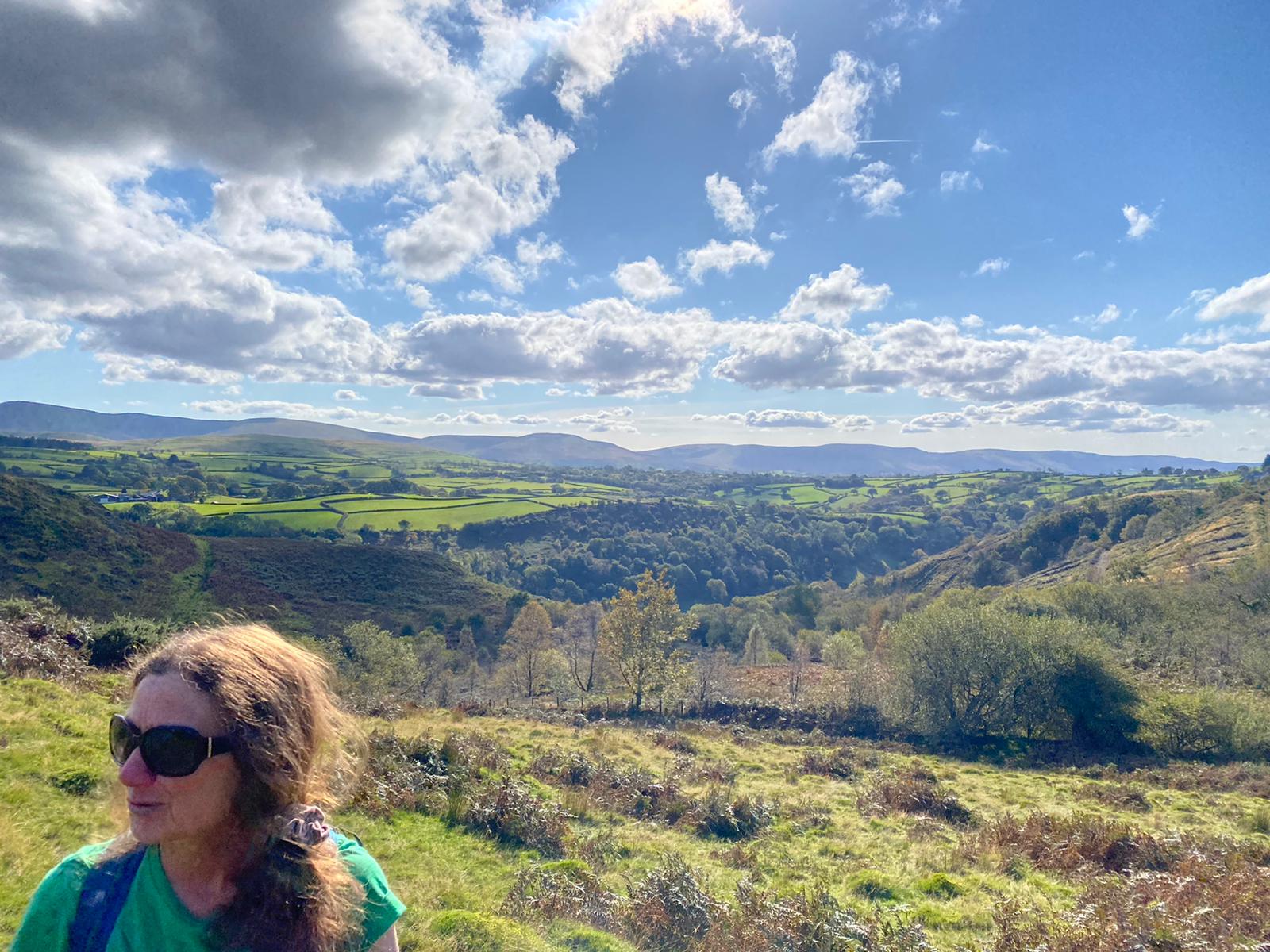
Myddfai Common, Bannau Brycheiniog
The running man and the pony

At New Year, I took on the care of two ponies. Both had been living on the common by my house for some months, owned by Mike, a local man who became too unwell to care for them. They are just two years old and the boy, who I call Little Bob, has one black ear and one white, curved like a yin-yang symbol. My neighbour called the filly Scrufty, a blending of scruffy and tufty, as her coat was a little matted at first. Now she is a girl of brushed flowing locks, as fluffy as a My Little Pony.

Mike had already rescued Scrufty once, as a foal, from conditions that sounded pretty grim. It explains her reticence with humans – Little Bob walks confidently over to anyone, searches their pockets for treats, leans into any hand for a scratch. Scrufty is wary, eyeing people up from behind her exuberant fringe and often walking away with an air of equine indifference. Whatever has happened in her short life has left her hesitant and I am still uncertain how much she enjoys my company. For four months now, the ponies have bookended my days on the common – they get their buckets of breakfast after the hens, but before my own; I check them again at dusk, when the song thrush sings behind my garden and the tawny owls call in the wood. Visiting the ponies has become a focal point for my night time rambles too, and often now I stand with the black and white horses a while in the moonlight and shadow.

One evening last week I spotted the Running Man crossing the common. I don’t know his name, only that he lives in a residential home for adults a mile or so away and has run or walked past my house every day for more than two decades. Over the years, I’ve watched his dark beard become speckled with grey, but we have never spoken. He will raise a hand whilst looking straight ahead, clearly uncomfortable with eye contact or speaking. This time he waved at me, a full-armed and enthusiastic gesture, and walked towards where I was standing with the ponies. I waved back, surprised at his exuberance, telling myself to be calm, to let him take the lead in our contact. ‘I have seen the horses’ he said, ‘I have seen the horses, can I touch one?’

I pointed towards Scrufty, who was nearest to him and muttered something about approaching her quietly. The tall man walked towards her, an arm held stiffly out in front, towering over the little pony. I was worried she would back off, freaked out by this sudden human in Hi-Viz and thinking I’d go over and help if I was needed. Instead, she wandered over to him slowly, sniffed the proffered hand and reached her head up to nuzzle his shoulder. A huge grin spread over the Running Man’s face and he ran his fingers through the softness beneath her long mane. I let them be, alone with whatever communication was flowing between them. Then the man turned to me, held up his hand, and said ‘thanks’. I told him he was welcome to chat to them anytime, but he had picked up speed and was gone into the dusk.

I’ve spent a lot of my life with horses – dun-coloured Zodiac, who I sat on as a child, behind the glasshouse of a market garden, Dougal, who I rode bareback in the fields by a coal yard in Scotland and Perkins, the white and gold pony I drove in a cart down Norfolk lanes for fifteen years. I used to call him my grass-powered pickup truck – one less four-by-four I would say to my friends as we bowled along the lanes to the pub. Each of them, like all horses, lived in the present moment, easily scared, but sensitive to human behaviour. Building trust with them can take time, but once won it feels like the warm depth of falling in love, my heart turning over as they follow me across a field or run their soft lips gently across my palms. I don’t know if the Running Man will visit Scrufty again, but I hope he does – both of them seemed to benefit from that moment of contact and I’d been waiting weeks for little signs that her confidence is growing.

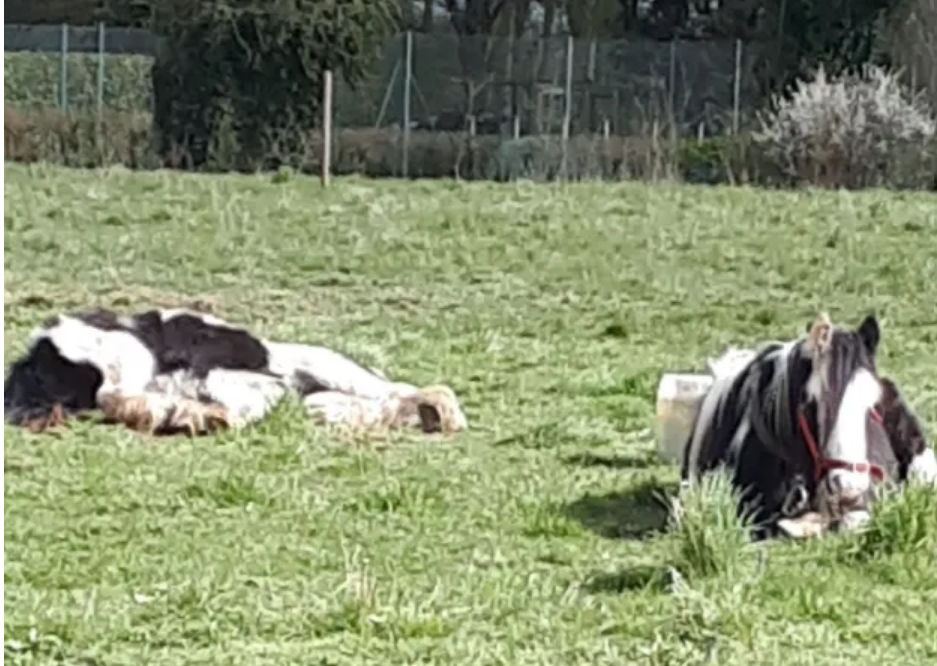
Sleepy ponies. Helen

A Common Land Year

January

I’m writing about common land. I have enough words for a book now, one that wanders from rain-soaked Cumbria to meetings on Dartmoor, via Gypsy horses in Scotland and herbalists in Wales. Words that return, always, to the common outside my front door. It is a place I have known all my life, sixteen acres of tussocky grassland, scrub, gnarled oak trees and ponds that come and go with the rainfall and seasons. It is a land that has shaped my life too; identifying wild flowers here as a child led to me training as an ecologist and, as I became more aware of the threats to the wild, to me becoming an environmental activist. The commoners that were here in my childhood kept goats, donkeys, ponies and a cow on the rough grazing, whilst their gardens were busy with hens and vegetables and firewood piles. They too inspired my dreams, instilling a desire to live quietly and meet my own needs where I can.

I am writing about common land in Britain today. When I say this, I get one of several responses. Some people are excited and we veer into rambling conversations full of enthusiasm for vegetable gardens and coppice woods. Others tell me all that they know about commons, and a subset of them embark on long rants about enclosure, even though I say I am writing about the present more than the past. I have learned that my role here is to listen, rather than to converse. My favourites are the people who tell me about ‘their’ commons, the places close to their hearts, where they walk, work, graze animals or simply enjoy a landscape that feels rooted in history and nature.

I like to start conversations about commons with a question – ‘what do you understand ‘common land’ to be?’ The answers are varied, with many believing that the land is un-owned, or owned ‘by everyone’ or ‘the people’. I am the buster of common land myths and tell them that are two answers to my query. Firstly, since the 1960s, common land and common rights are defined by registers held by local authorities. If the land does not have an entry in the typescript ledgers and an accompanying, hand-drawn map, it may once have been a common, but it is not now legally one. Secondly, in the past, common land was simply land owned by someone, but over which other people] had rights. Either way, there are usually owners in the form of local farms, estates, local authorities or conservation groups. Wood Green, the common on my doorstep, is registered, along with my rights for grazing animals. On other commons there are entitlements for cutting peat for fuel, coppicing or pollarding firewood, grazing pigs in the oak and beech mast season, for fishing and for digging up road stones.

Once there was common land everywhere, reaching into cities, surrounding villages and towns. Thousands of acres of moor and fen, heath and forest, and rough grass and scrub like my home ground. Over hundreds of years it was enclosed into privately owned fields, concentrating property into the male lineage of country squires and landed gentry. I’ve spent a long time reading the reasons why enclosure happened and about the consequences on communities and ecology. Those are for my book, or perhaps for later posts in my common land year. I’ve also hunted out where commons hide in plain sight in old paintings and English literature – they are there in the novels of Jane Austen, Thomas Hardy and Charles Dickens; they are in the paintings of Gainsborough and Constable and in the poems of John Clare, who recorded the enclosure of his village commons in the early nineteenth century.

Clare has been a companion of mine since my teens, when my mum came back from an evening class carrying a book of his poems and clearly in love with the words of the long-dead farm labourer from Northamptonshire. Like Clare, I have seen places I loved destroyed, this time for road-building – a chalk hill called Twyford Down, an old heathy common in the path of the Newbury bypass and a small fragment of old common in north-east London. ‘Enclosure like a Bonaparte let not a thing remain’, wrote Clare in his poem Remembrances. ‘It levelled every bush and tree and levelled every hill’, he continues, and when I read his words, there are tears in my eyes for the lands that both of us lost.

Today, in early January, the ice and snow on the common melted. I carried water and hay out to the ponies that live there, feeling their warm breath on my hands as they searched for treats. Despite the thaw, the ground seems dry, the ponds barely topped up after nearly two years of scant rain. It scares me, this changing and uncertain climate, the questions of ‘what if’. What if the ponds are not full enough for the frogs and the newts and the shy dabchicks who breed here in spring? What if there is barely enough rain for the wild flowers to bloom and if the trees shrink into themselves, as they did last year, shedding limbs and barely growing? What if there are not enough flying insects for the swallows or swifts and the birds fail to return in the first weeks of summer? My love of this common isn’t easy, most days I find some solace in these quiet, but to love a half-wild place is to fear for its future.

I have more than enough words for a book now, they are almost all lined up and seeking a publisher. Yet more keep coming, as if my business with common land is not finished, so these posts will be outtakes that don’t make it to the book, reflecting the commons I visit this year and the people, histories and wildlife I find on them. I am not sure where I am going next. I’ll let you know.