A Common Land Year, April

Lark Rise and other ghosts

I am more than a week late writing this, it should have been penned at the end of May, but I spent a long weekend travelling to Wiltshire, losing writing time to walking on chalk downs. On the way home, I stopped to look for a ghost on Juniper Hill. It might have been more than one ghost, for although I have never visited the village, which sits on a low hill north of Oxford, it has a place in my memory. In the summer of 1989, I spent a week in hospital. The nights were hot and I struggled to sleep, so I spent most of each day and night reading. Flora Thompson’s Lark Rise to Candleford was one of the books I had taken with me. It had been recommended by college lecturer, who talked of how it recorded rural life in the decade or so before the First World War. I was intrigued when he said that Lark Rise was one of the very few books of its era written by a rural working class woman. I’ve re-read it a couple of times since that summer and the prose trips lightly along, weaving Thompson’s own story into the life of the village, its seasonal celebrations, its occasional conflicts and the poverty of her family and neighbours.

Lark Rise was name Thompson at thgave to her birthplace of Juniper Hill and, heading home from Wiltshire, I followed the long straight road to see what was there now. The lane was quiet and ran beside a cluster of houses and wide fields of oil seed rape, flowering yellow beneath a blue sky. There was no sign of any people, only cars parked behind hedges or fences – a contrast to the bustling, gossipy community depicted in Lark Rise.

The ghosts of common land haunts Thompson’s childhood. By the time she was born, the open fields and shared pastures had long been enclosed; replaced with neat hedged meadows and ploughed acres. Yet a memory of the commons lingers on. Thompson writes of her grandparent’s house, with its velvet cushions and dark carved furniture – luxuries she says they could afford because they had had common rights in their younger days. The rights meant they had kept geese and cows on the commons, as well as a donkey to pull a cart of eggs and butter and cheese into market for them to sell. Their income as servants or labourers was supplemented by the sale of these goods, so they had been better off than Thompson’s own family. Even though Flora’s father was a skilled stonemason, her parents were entirely reliant on him finding employment.

Passing through the village, I wondered at the place name too – juniper bushes like chalk downland or open moors and the edges of woodlands. Maybe the village was once surrounded by rough grazing, with patches of trees and tangled scrub. There was no sign of any juniper in the vast fields I saw on my visit, but then I barely left the car, uncertain where to park or where I could walk away from the road.

The ghosts of commons can be found in place names across England. Within a few miles of my Norfolk home there is: North Green, Bush Green, several Common Roads, Lundy Green, Blythe Green, which is no more than a few trees and a cottage at a turning in the road, Penny’s Green, The Common, now a row of houses next to wheat fields, Harris Green, Silver Green, High Common, Low Common and Cole’s Common. None of them have any common land anymore. The words ‘green’ and ‘common’ were mostly interchangeable in lowland England, once simply signalling unfenced land where people had rights. Further away there are a couple of ‘moors’, which used to mean a rough and unenclosed pasture and not necessarily a heathery hillside. I also think I can spot the outline of lost commons in a few wide verges or where a row of old cottages face onto a track that might once have crossed a common.

When I first moved here, I spent a spring and summer exploring local lanes on my bike, passing by arable fields, but finding road verges rich in wild flowers – ox-eye daisies and orchids, cowslips and lesser bird’s foot trefoil, field scabious and yellow oat grass. I wondered if these too were the ghosts of common land, once grazed and interconnected by trackways. I followed the question with research, mapped the wildflower verges close to my home and found that each one matches the location of a long ago common. Just as English bluebells on mountains or in hedgerows can show where woods used to be, so the plants of old meadows and pastures can show where the commons once were.

Driving home from Juniper Hill in a long, late evening, with the setting sun behind me, I wondered how many other lost commons remained in the places I passed. They may only survive as names, as village greens, a handful of flowers, or odd-shaped corners of ground, but their ghosts are part of how we understand the land and our relationship to it. I am cautious of nostalgia, of romanticising the past – Thompson’s book shows how hard the lives of the rural poor can be – access to commons or not. Understanding enclosure, however, helps us grasp why we are one of the most nature depleted countries in Europe, with land seen primarily as an asset for making money, regardless of the lives, human or more-than-human, who live there.

The loss of our commons as places where we interact with nature is also part of why people in Britain feel so little connection with nature. For centuries, common land was part of many people’s lives – whether they rambled and climbed trees like John Clare or kept cows like Flora Thomson’s grandparents. Commons reached into the heart of medieval towns and cities too, as places for gathering firewood and stones and keeping animals on the nights before markets. A recent study by the University of Derby calculated the loss of nature from people’s lives as around sixty percent since 1800. The decades either side of this date were the peak of the enclosure of commons, and of people needing to seek alternatives to farm work through learning skilled trades or migrating to industrial towns.

Arriving home, I walked the boundaries of the common outside my gate before sunset, thankful to my mum for registering it as common. Every time I do this, I think it is not enough. Both us and the wilder lives we live among need more spaces like this to thrive, to gather blackberries for crumbles and gorse flowers for wine, and, through valuing nature, to act as mum did and protect it. Re-connecting with nature is not just about our wellbeing, but crucial to creating a wilder, healthy world for the future, and, ultimately, to ensuring our species’ survival on this Earth.

The spectres of England’s commons have many stories to tell and I wonder, as I write these words, how many other people out there have the ghost of a common nearby – I would love to see pictures of them and hear their stories.  

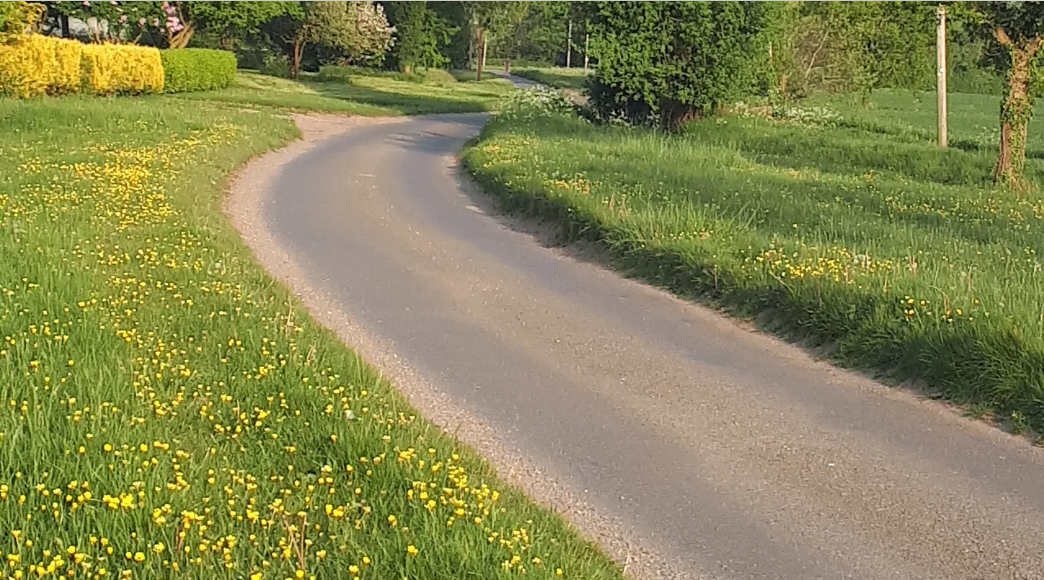
Bulbous buttercups at Shelton Spot, the ghost of a common in Norfolk. H Baczkowska

* Modelling Nature Connectedness Within Environmental Systems: Human-Nature Relationships from 1800 to 2020 and Beyond

A Common Land Year, March

At Swaddy Well

I thought about Swaddy Well all the way from Norfolk to the Northamptonshire village of Helpston. Driving across the Fens, wondered if I could find it, if it would be more than a name on a map and the memory of a place. Beneath the wide, grey skies beyond my windscreen, the reeds in the drainage ditches stood bleached by the winter. March was ending like a pacing lion, the north wind carrying a hesitant drizzle.

In Helpston, I met friends in the café attached to the museum that was once the home of the poet John Clare, who was born in the village in 1793. When we walked through the gift shop to the white-washed cottage, I was struck by the cold. No fire, just the kitchen laid out as if someone had come in from a summer garden and placed apples on the table beside slices of bread and hard, cheap cheese. A small bowl held convincing glass raspberries.

I wondered what rights Clare’s family had claimed on the commons at the edges of his parish, on Emmonsale Heath, the Mores and Swaddy Well. Maybe grazing for a pony, geese or cattle, entitlements to wood for the fire or for whittling into spoons, perhaps a right to catch fish or cut turf – all of them supplementing the living of a poor family. Common rights, like my own at Wood Green, are still often linked to the hearth of a house and are what has defined common land for centuries; no matter who owns the ground, the right holders’ access to the grass and timber should prevail.

Clare’s poem, ‘The Lament of Swaddy Well’, recounts the enclosure of a common into cropped, farmed fields and a quarry. By the time of the Norman Conquest, ‘open field’ farming existed in much of the English Midlands, with villagers having rights on common grazing land and hayfields and ‘owning’ a number of strips marked with posts in the parish’s arable fields – the origin of the term ‘stakeholder’. In 1760, a new legal process speeded up the gathering of the strips into individual farms that could be rented out or farmed for profit more than subsistence. Common rights were dissolved by this process and the pastures ploughed up, whether or not the rightholders agreed. These ‘parliamentary enclosures’ were frequently led by an individual who had acquired most of the strips in a parish and it could be carried out even if the majority of those ‘owning’ land in the village opposed the idea. The deciding factor was not the number of stakeholders who consented, but the agreement of those who owned the largest share of the land. Owning land of significant value was then the backbone of power in Britain and the required route for becoming a Justice of the Peace or a Member of Parliament – the very people who would rule on private enclosure acts laid before them by other landowners. Between 1760 and 1870, nearly seven million acres of common land in Britain were enclosed and commoners, deprived of their rights, were left with only their waged labour to live on[i]. ‘Where profit gets his clutches in’, writes Clare, ‘there’s little he will leave’.

The Lament of Swaddy Well is written from the point of view of the land as it says farewell to the Gypsies who camped among its bushes, to commoners and the wild creatures of its ‘old, green hills’. It is one of the most eloquent texts on habitat destruction in English, voicing sorrow at the obliteration of beetles ‘hiding ‘neath a stone’, flowers ‘that bloomed nowhere beside’ and the butterflies that ‘whirr and come’. I feel my voice wavering if I try to read it aloud, recognising in the words my own landscapes of loss – the chalk hill that was once Twyford Down, with its wild flowers, skylarks and bees, or the old oak trees at Skinner’s Green, on the route of the Newbury bypass. I am not surprised that Clare’s sanity collapsed as the places he knew were destroyed. Many of my road protest friends suffered breakdowns and struggled for years to find their place in the world, yet we had known those woods and valleys and rivers only briefly, whereas Clare was grappling with the destruction of the ‘mossy hills’ and ‘silver springs’ he had walked among all his life.

Despite the enclosures of commons that Clare saw in his lifetime, over a million hectares of common land remain in England and Wales today[ii]. More than a third of this area is designated as nationally important for nature conservation, a testimony to its history. The long use by right holders means that commons are not truly ‘wild’, but they have had a long time to develop peat soils, or the plants of ancient grasslands and heaths, and to be a familiar haven for generations of migrant birds. These old lands are, however, still places of conflict. My journey through Britain’s commons, currently being shaped into a book, have taken me to the burnt squares of heather on grouse moors, the enclosure of a common for military training, the industrial scale digging of peat in northern England, and the sheep-cropped turf of Welsh commons. Each of these has a story of carbon capture and climate change, flood control and the continual dwindling of nature; like the Fens that I crossed on my trip to Clare’s cottage, they are stories for another day, or for the longer pages of my book.

In Helpston, the small group of us who had met in the café braved the keen March wind and the drizzle to visit Swaddy Well. A red kite drifted over thorn scrub as we arrived and a flock of black sheep eyed us warily from a distance. The limestone cliffs of the abandoned quarry were still exposed, facing a shallow lake fringed with reeds, young birch trees and the spiky skeletons of last summer’s thistles. Wading into a pond, I found a few great crested newt eggs, tucked neatly under the leaves of a plant. In the shelter of a hut, we took turns at reading out the verses of Clare’s Lament. Tears pricked a little at my eyes and yet, there was a hopefulness in the battered land around us and in the kite, a species returning to Britain after years of persecution and near extinction. Swaddy Well, I found out, is more than a place on a map or the ghost of a common, it’s a reminder of how, with benevolent care, even the most mistreated places can find their way back to the wild.

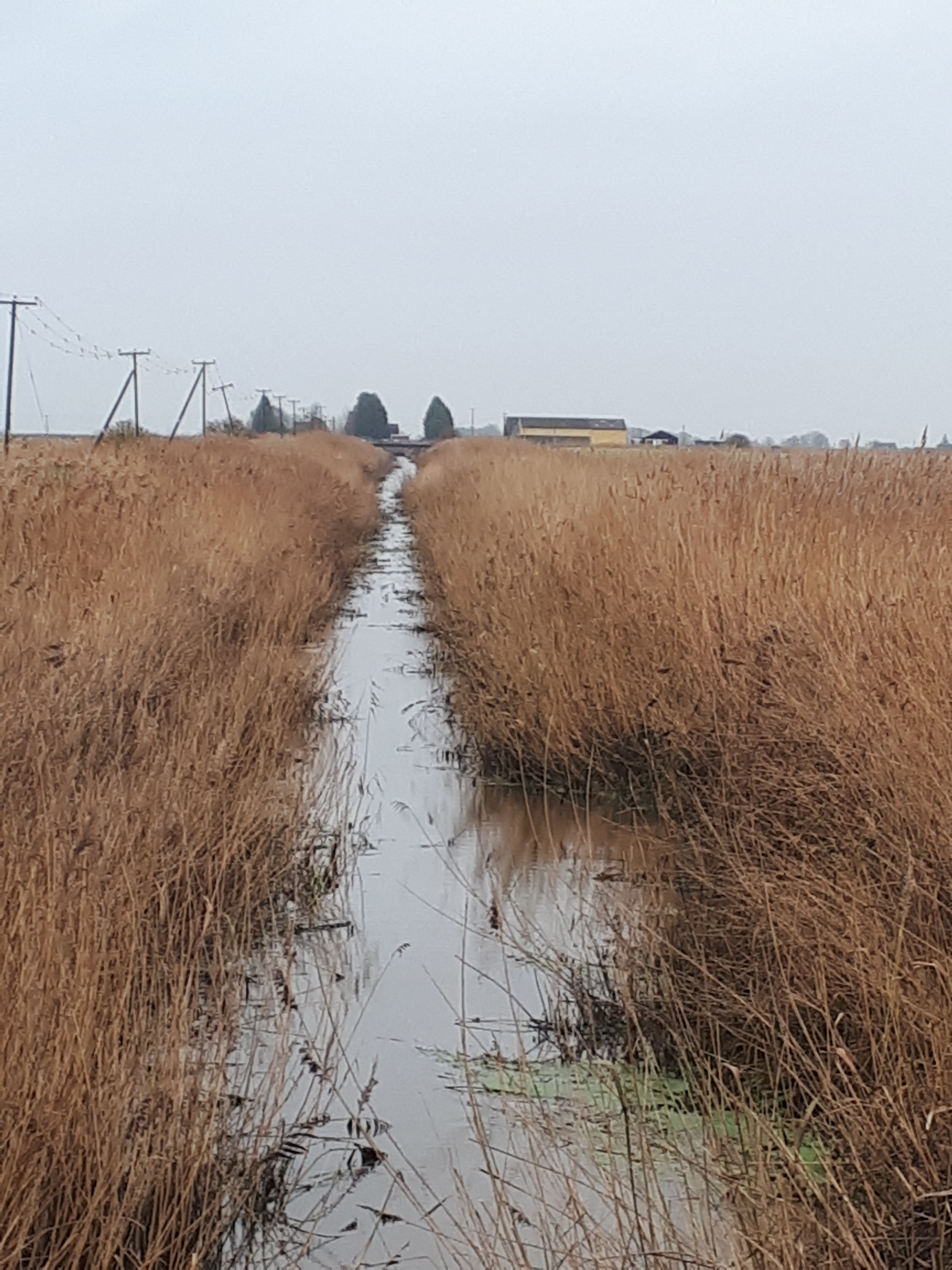
Dyke looking towards Engine Farm in The Fens; a steam pump bought at the Great Exhibition in 1851 was installed here to drain one of the last shallow lakes of the landscape. H Baczkowska


[i] A Short History of Enclosure, Simon Fairlie, The Land, https://thelandmagazine.org.uk/articles/short-history-enclosure-britain

[ii] Foundation for Common Land, https://foundationforcommonland.org.uk/