Lark Rise and other ghosts
I am more than a week late writing this, it should have been penned at the end of May, but I spent a long weekend travelling to Wiltshire, losing writing time to walking on chalk downs. On the way home, I stopped to look for a ghost on Juniper Hill. It might have been more than one ghost, for although I have never visited the village, which sits on a low hill north of Oxford, it has a place in my memory. In the summer of 1989, I spent a week in hospital. The nights were hot and I struggled to sleep, so I spent most of each day and night reading. Flora Thompson’s Lark Rise to Candleford was one of the books I had taken with me. It had been recommended by college lecturer, who talked of how it recorded rural life in the decade or so before the First World War. I was intrigued when he said that Lark Rise was one of the very few books of its era written by a rural working class woman. I’ve re-read it a couple of times since that summer and the prose trips lightly along, weaving Thompson’s own story into the life of the village, its seasonal celebrations, its occasional conflicts and the poverty of her family and neighbours.
Lark Rise was name Thompson at thgave to her birthplace of Juniper Hill and, heading home from Wiltshire, I followed the long straight road to see what was there now. The lane was quiet and ran beside a cluster of houses and wide fields of oil seed rape, flowering yellow beneath a blue sky. There was no sign of any people, only cars parked behind hedges or fences – a contrast to the bustling, gossipy community depicted in Lark Rise.
The ghosts of common land haunts Thompson’s childhood. By the time she was born, the open fields and shared pastures had long been enclosed; replaced with neat hedged meadows and ploughed acres. Yet a memory of the commons lingers on. Thompson writes of her grandparent’s house, with its velvet cushions and dark carved furniture – luxuries she says they could afford because they had had common rights in their younger days. The rights meant they had kept geese and cows on the commons, as well as a donkey to pull a cart of eggs and butter and cheese into market for them to sell. Their income as servants or labourers was supplemented by the sale of these goods, so they had been better off than Thompson’s own family. Even though Flora’s father was a skilled stonemason, her parents were entirely reliant on him finding employment.
Passing through the village, I wondered at the place name too – juniper bushes like chalk downland or open moors and the edges of woodlands. Maybe the village was once surrounded by rough grazing, with patches of trees and tangled scrub. There was no sign of any juniper in the vast fields I saw on my visit, but then I barely left the car, uncertain where to park or where I could walk away from the road.
The ghosts of commons can be found in place names across England. Within a few miles of my Norfolk home there is: North Green, Bush Green, several Common Roads, Lundy Green, Blythe Green, which is no more than a few trees and a cottage at a turning in the road, Penny’s Green, The Common, now a row of houses next to wheat fields, Harris Green, Silver Green, High Common, Low Common and Cole’s Common. None of them have any common land anymore. The words ‘green’ and ‘common’ were mostly interchangeable in lowland England, once simply signalling unfenced land where people had rights. Further away there are a couple of ‘moors’, which used to mean a rough and unenclosed pasture and not necessarily a heathery hillside. I also think I can spot the outline of lost commons in a few wide verges or where a row of old cottages face onto a track that might once have crossed a common.
When I first moved here, I spent a spring and summer exploring local lanes on my bike, passing by arable fields, but finding road verges rich in wild flowers – ox-eye daisies and orchids, cowslips and lesser bird’s foot trefoil, field scabious and yellow oat grass. I wondered if these too were the ghosts of common land, once grazed and interconnected by trackways. I followed the question with research, mapped the wildflower verges close to my home and found that each one matches the location of a long ago common. Just as English bluebells on mountains or in hedgerows can show where woods used to be, so the plants of old meadows and pastures can show where the commons once were.
Driving home from Juniper Hill in a long, late evening, with the setting sun behind me, I wondered how many other lost commons remained in the places I passed. They may only survive as names, as village greens, a handful of flowers, or odd-shaped corners of ground, but their ghosts are part of how we understand the land and our relationship to it. I am cautious of nostalgia, of romanticising the past – Thompson’s book shows how hard the lives of the rural poor can be – access to commons or not. Understanding enclosure, however, helps us grasp why we are one of the most nature depleted countries in Europe, with land seen primarily as an asset for making money, regardless of the lives, human or more-than-human, who live there.
The loss of our commons as places where we interact with nature is also part of why people in Britain feel so little connection with nature. For centuries, common land was part of many people’s lives – whether they rambled and climbed trees like John Clare or kept cows like Flora Thomson’s grandparents. Commons reached into the heart of medieval towns and cities too, as places for gathering firewood and stones and keeping animals on the nights before markets. A recent study by the University of Derby calculated the loss of nature from people’s lives as around sixty percent since 1800. The decades either side of this date were the peak of the enclosure of commons, and of people needing to seek alternatives to farm work through learning skilled trades or migrating to industrial towns.
Arriving home, I walked the boundaries of the common outside my gate before sunset, thankful to my mum for registering it as common. Every time I do this, I think it is not enough. Both us and the wilder lives we live among need more spaces like this to thrive, to gather blackberries for crumbles and gorse flowers for wine, and, through valuing nature, to act as mum did and protect it. Re-connecting with nature is not just about our wellbeing, but crucial to creating a wilder, healthy world for the future, and, ultimately, to ensuring our species’ survival on this Earth.
The spectres of England’s commons have many stories to tell and I wonder, as I write these words, how many other people out there have the ghost of a common nearby – I would love to see pictures of them and hear their stories.
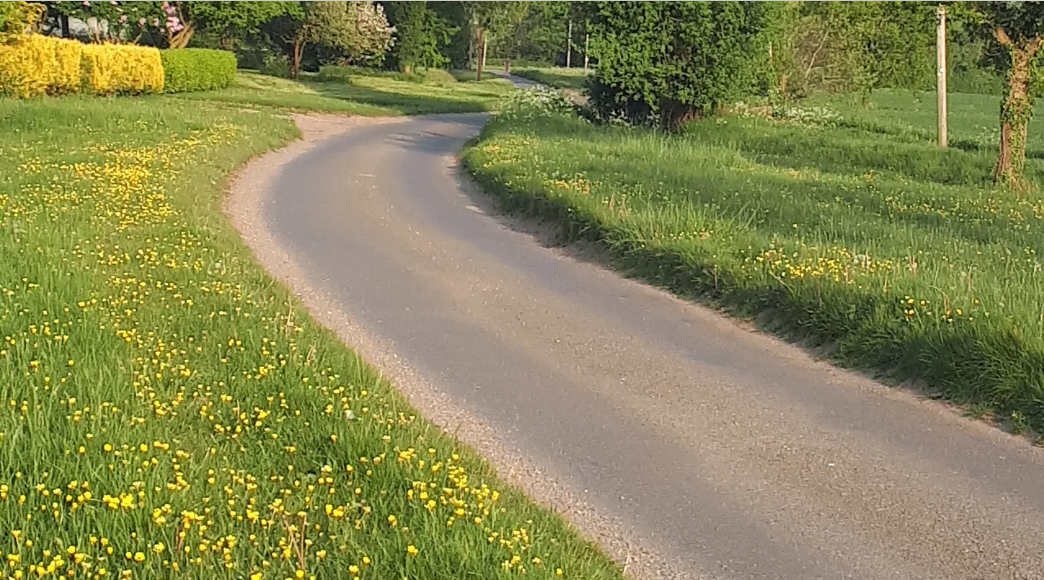
Bulbous buttercups at Shelton Spot, the ghost of a common in Norfolk. H Baczkowska

