A common land year, July 2026
The evening air was still hot as I walked towards Sheep’s Green. It felt only slightly cooler than the relentless sun of the day, and the people around me still wore shorts, t-shirts and the lightest of dresses. When I reached the Green, a small dog was running in circles, two children chased each other over the dry, brown grass and small groups sat in the shade of the trees.
Sheep’s Green is one of a series of commons that edge the old part of Cambridge, the part where the stone-walled colleges, with their porter’s lodges and neatly mown quads, nestle into a curve of the river Cam. To the north and east of Sheep’s Green is Midsummer Common and nearby is Lammas Land – both names a legacy of how the land was once managed, with the grazing closed, or ‘shut up’ until after midsummer on one and after Lammastide on August the first on the other. Sheep’s Green is mostly likely named for its grazing flocks and just north of it is Launderess Green, which author Margaret Keynes thought originated in the use of the land by the washerwomen of the colleges and the two adjacent parishes[i].
Urban commons like Sheep’s Green and its neighbours occupy the fringes of many of England’s cities. Norwich, a few miles from my home, has the sandy hummocks and hills of Mousehold Heath, Newcastle has Town Moor (‘moor’ originally indicated unenclosed land), and in Southampton the sprawling wildness of the Common feels like a fragment of the New Forest, stranded now in an ocean of busy streets. Once these commons were grazed by the dairy herds that supplied milk to citizens, and stood at the end of the drove roads, where geese and cattle and sheep were brought for market and slaughter. John Constable’s paintings of Hampstead Heath, dating from the 1820’s, show cows and donkeys grazing on the hills above London, as well as labourers with carts who could be collecting stones, or might be dumping waste from the rapidly expanding streets of the city below. Constable did not, however, paint the squatters who lived in hastily-made tents and shacks on Littleworth Common, just north of Hampstead. A commentator at the time called it one of the few places close to London where ‘a displaced and impoverished rural population could build hovels and supplement casual jobs with a little livestock grazing, rabbiting and pilfering’.
Littleworth was far from the only informal camp established on common land in British history; in 1381, the outraged people of the Peasants Revolt, protesting about a poll tax and common land enclosures, established themselves on the unenclosed acres of Blackheath on the edges of London. In 1549, Kett’s Rebellion in Norfolk was the biggest of a series of uprising across England resulting, again, from enclosures and taxes passed on to the poorest of the land. Robert Kett and his followers lived all summer on Mousehold Heath, before being defeated in a bloody battle at Dussindale, on its eastern flank. Kett himself was eventually captured by soldiers and hanged from the battlements of Norwich Castle, his body left on display as warning to other would-be dissenters.
Three hundred years later, in 1848, Chartists gathered on Kennington Common south of Westminster, this time just for the day. With fluttering flags and speakers standing on the back of a cart, they issued their demands, originally set out in the long charter that gave them their name. They were seeking to level the political playing field, for adult men at least, and called for universal male suffrage, a secret ballot, annual elections, equitable representation and salaries for Members of Parliament, enabling those without a private income to be elected. At the time these were considered deeply subversive and armed guards were placed around notable London buildings on the day of the rally. Today almost everything the Chartists called for is enshrined in Britain’s laws. One response to the rally, however, was to quickly enclose Kennington Common, turning it into a formal park, with fences, shrubberies and flowerbeds installed to deter further gatherings.
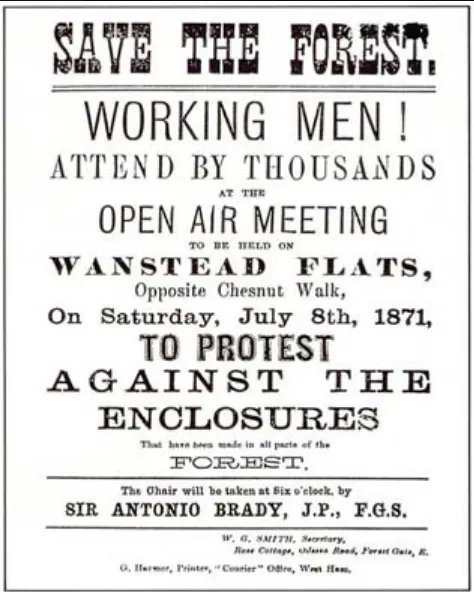
In 1865, the Commons Preservation Society (called the Open Spaces Society today), formed to challenge the enclosures of Wimbledon Common, parts of Hampstead Heath and other common land around London. Led by early Socialists, including the designer William Morris, enclosures were fought through the courts and by supporting the tearing down of illegal fences. In July 1871, as a court case challenging enclosures on Epping Forest, an outdoor meeting was organised to oppose the building of houses on Wanstead Flats to the south of the Forest. The open land of Epping Forest was known as ‘the Cockney Paradise’, with tea houses, and amusements that were enjoyed by workers from the East End. As the fences went up at Wanstead, posters displayed across London urged ‘working men’ to ‘attend by thousands’ and challenge the illegal enclosures created by Henry Wellesley, the younger brother of the Duke of Wellington. Attend in their thousands they did, both men and women incensed by the loss of a place where they walked and played; I imagine too that, with the years of Chartism behind them, they had a growing sense of their own agency.
In the following decades, a series of new laws recognised the importance of common land as places where urban populations enjoyed a right to ‘fresh air and exercise’. Octavia Hill, a founder of the Commons and Open Spaces Society (and later of the National Trust), phrased this more poetically, ‘We all need space’ she said, ‘unless we have it, we cannot reach that sense of quiet in which whispers of better things come to us.’
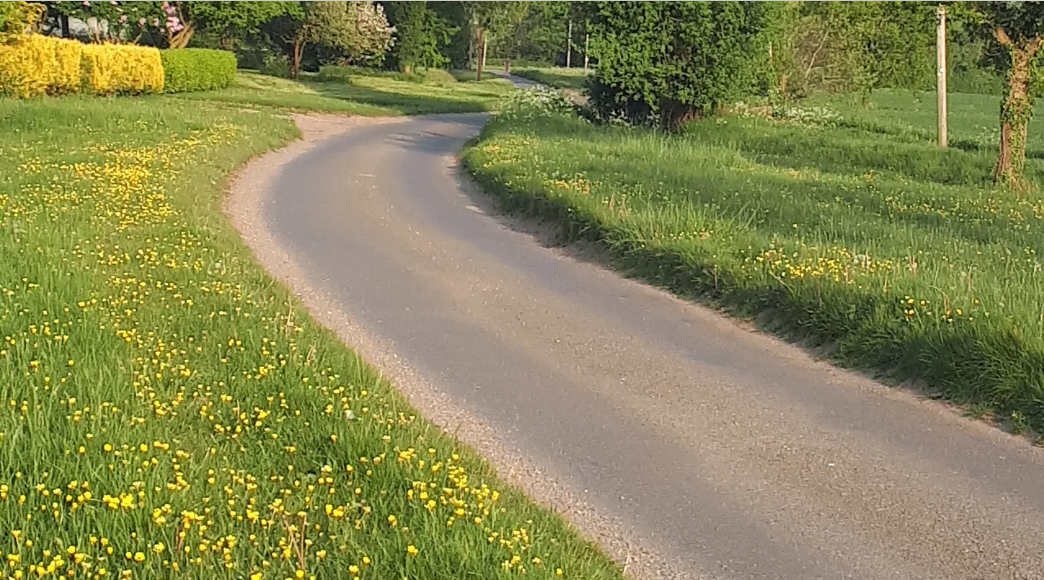
Despite the children, picknickers and dogs, enjoying their rights to fresh air and exercise, Sheep’s Green, when I cross it, appears very different from a park. It has an irregularity to it, with humps and bumps from old stream channels or pits and odd tangles of bushes. It might be my imagination, but it feels like the ghost of the ramshackle commons of lowland England. Like the other commons around Cambridge, there are also reminders that this land is still grazed – kissing gates or turnstiles at the entrances, small cattle grids on the cycle paths, and litter bins designed to deter the noses of inquisitive animals.
In recent years, the long tradition of grazing of Cambridge commons has been threatened as the city council has sought to axe their funding for ‘pinders’. Pinder is a medieval term, usually applied to the officer of a manorial court who was responsible for impounding stray animals – often those that should not have been loosed on a common. In modern Cambridge, the pinders rescue animals that get in trouble on the commons – a consequence, often, of their close proximity to people and bicycles and roads. The cattle owners have stressed the high risks of grazing urban commons and the importance of cows grazing the commons – reducing mowing costs and helping nature conservation. The council just says it needs to cut spending and that the graziers should shoulder the additional costs themselves. From where I stand, on the sidelines, it is proof, if any was ever needed, that common land is still shrouded in conflict.
Heading back to the station from Sheep’s Green, detouring via the Lammas Land, I wondered how much sustenance there was for grazing animals in the grass this year, and wondered too when the rains would come to bring the dried brown leaves back to life. I thought of how the conflicts surrounding Cambridge’s commons, as so often on common land, stem mainly from how many different expectations we have of it. Only five percent of England and Wales is registered as common land, but for over a century now these have become not just places where people graze animals or collect fuel, but where they seek many forms of fresh air and exercise – cycling, horse riding, running, walking, giving pet dogs a run. So many expectations in so few places is proving hard to manage and leaves me thinking that what we actually need is more space not more laws, more common land where we can all seek out those whispers of better things.
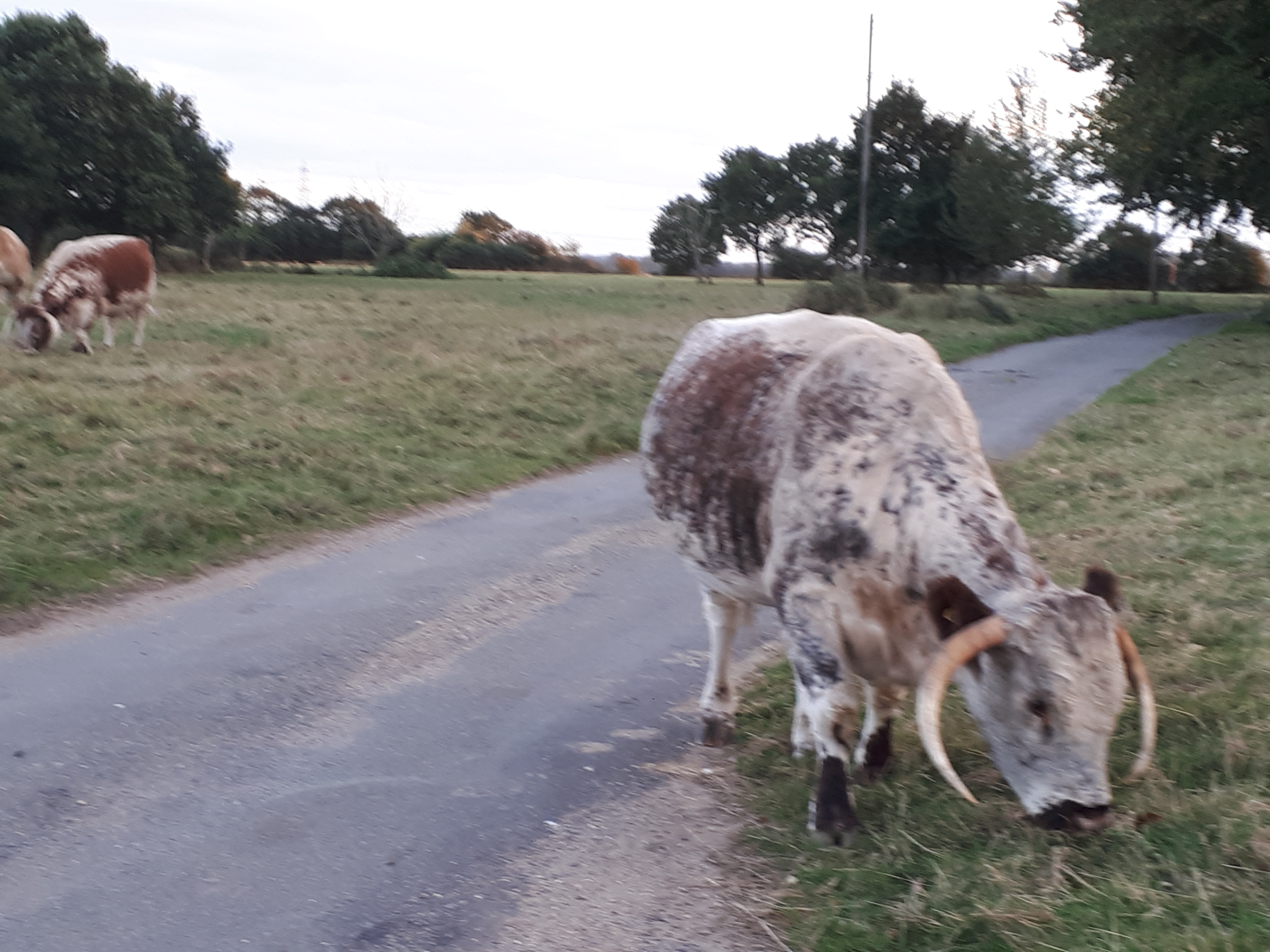
Long horn cattle grazing on a common in the East Anglian Fens
[i] A house by the River, ME Keynes 1976
You can also find me on Substack: as commonplace 92