Leigh guided me out of the farmyard behind her mum’s house, through a rusting wrought iron gate, and onto a path not marked on any map. Leigh was dressed for her morning run, light-footed in trainers and with her long, dark hair gathered back from her face. I stomped after her in my boots. We’d left the house before my brother Jon, who is also Leigh’s partner, had woken up; above the trees that lined the narrow trail, the sky was the blue of an early summer morning, promising a warm day with barely a breeze. ‘I love this path’, said Leigh. It runs a short distance between two farms, but must, we thought, have been walked by generations of neighbours. Halfway along, we stopped for a moment on a bridge of a single plank across the Nant Glas stream: nant translates as ‘stream’, but glas in Welsh could mean blue or green or even silver. The running water looked dark and small below us and Leigh thought the levels were low for the time of year, adding that it had barely rained through the winter; ‘not like it used to’, she said.
After the stream, the path crossed a track that ran uphill to the common. Meeting people who grazed livestock on the common was the reason for our morning walk, but before we’d set out, I’d looked at the common on an OS map. It had told me that the track ended in sheepfolds – pens where the animals were once held for shearing, trimming feet or moving on somewhere else. The map showed the common as the pale beige of open access land, looped around with darker brown contour lines, cramped together to indicate slopes. There was evidence of centuries of land use too – prehistoric burial cairns, disused quarries and, marked by the gothic script that signifies antiquity, an old settlement high on the common. I had to remind myself that I was here to look at the common as it was now and not be distracted by its past.
Leigh led me across the track and into a farmyard, with orange baler twine twisted into a metal gate and a lightly rusting tractor parked among hay bales in a barn. The dusty smell of the hay mingled with sharp scents of diesel and the earthy aroma of cattle. At the farmhouse door, Leigh introduced me to Joe, before heading back to the track for her run. Joe, thin and bearded in his work-worn jeans, showed me through to the kitchen; the house reminded me of Leigh’s mother’s home, with low rooms of beams and dark wood, a modern extension on one side, and a sleek kitchen of straight lines at odds with the uneven, white painted stone walls.
In the kitchen, I met Joe’s wife Pam, she was small and dark and spoke as if she tolerated little nonsense in her life. Neither of them, they told me, is Welsh. When I asked about their relationship with the common at the end of the track, there was a moment of silence. For a moment I wondered if this was normal for them, if they were quiet people who thought before answering a question, or if there was some awkwardness they were considering before voicing a reply. In the end, they admitted they had stopped keeping sheep on the hill, firstly, they said, there was so little money in sheep farming, with fleeces worth less than the cost of shearing and meat prices impacted by cheaper imports. Then, Pam continued, she worries about the health problems that can happen when flocks from different owners mingle on the common. She chooses her words carefully, treading softly around a disquiet that other farmers show less concern about the wellbeing of their animals than she does. ‘We’ve opted for cattle instead’, says Joe, Welsh Blacks that can cope with the weather, poor grazing and uneven ground. Even so, Pam works to supplement their income and it seems as if there is little return on the hours they spend tending their beasts.
When I left Pam and Joe, and headed back along the path across the Nant Glas, my head was still full of questions. As an ecologist, I have long been aware of the debates over sheep grazing on Britain’s upland commons; decades ago, friends of mine used to call them ‘woolly maggots’, devouring vegetation and stripping the hills of scrub to shelter birds. Sheep grazing also reduces plant diversity and leaves the ground exposed in heavy downpours, reducing a landscape’s resilience to flooding. Yet the annual cycles of shearing, lambing, and gathering together to move flocks on and off the commons are anchor points in the year of hill farming communities. Swapping from sheep to cattle, as Pam and Joe have done, is often better for the land, as it allows steep slopes to grow scrub or even woodland, and reduces the close-cropping of plants carried out by sheep. It also requires new skills, different farming methods and capital investments many hill farmers do not have.
I was still mulling these thoughts over in the afternoon, when Jon and Leigh and I walked up to the summit of the common. My brother, who is six foot and blonde, scrambled among the rocks of the cairn at the top; in our youth we were both rebellious – me living on protest camps and he playing music at illegal raves. Now I am an ecologist and Jon is an archaeologist and his knowledge always gives me a deeper time history of the places we visit. I see medieval commons and later agricultural changes, whilst he spots Bronze Age field systems and Neolithic burial sites. Below us the land looked tightly grazed, with short grasses and bracken and no sign of trees. Leigh pointed out a criss-cross of shorter vegetation, where the grass and bracken had been cut in the autumn to create a break in case of wildfires. The summer has barely drawn breath, I thought, but wildfires have already burnt hilly commons to the north of the land above Nant Glas this year.
Mostly when I talk about commons, people want to dwell about the past, on long-ago enclosures, how they left British people with so little access to land and slowly cut off out connection to it. Yet, this hill, its short grass and dry ground is a reminder that some of our common lands are still here, and they are places where the climate and nature crises are happening in front of our eyes.
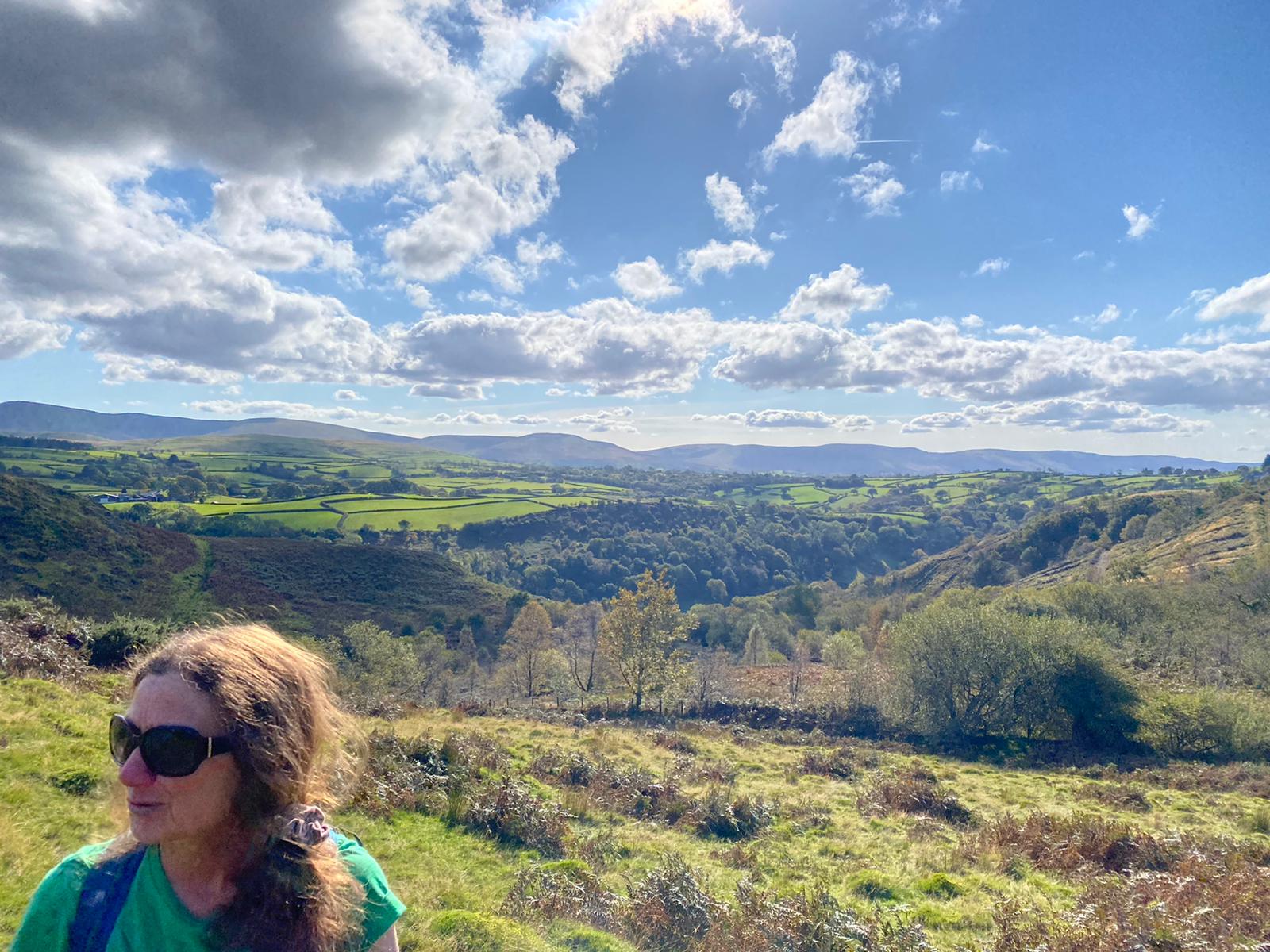
Myddfai Common, Bannau Brycheiniog

