A common land year, September

Flordon Common

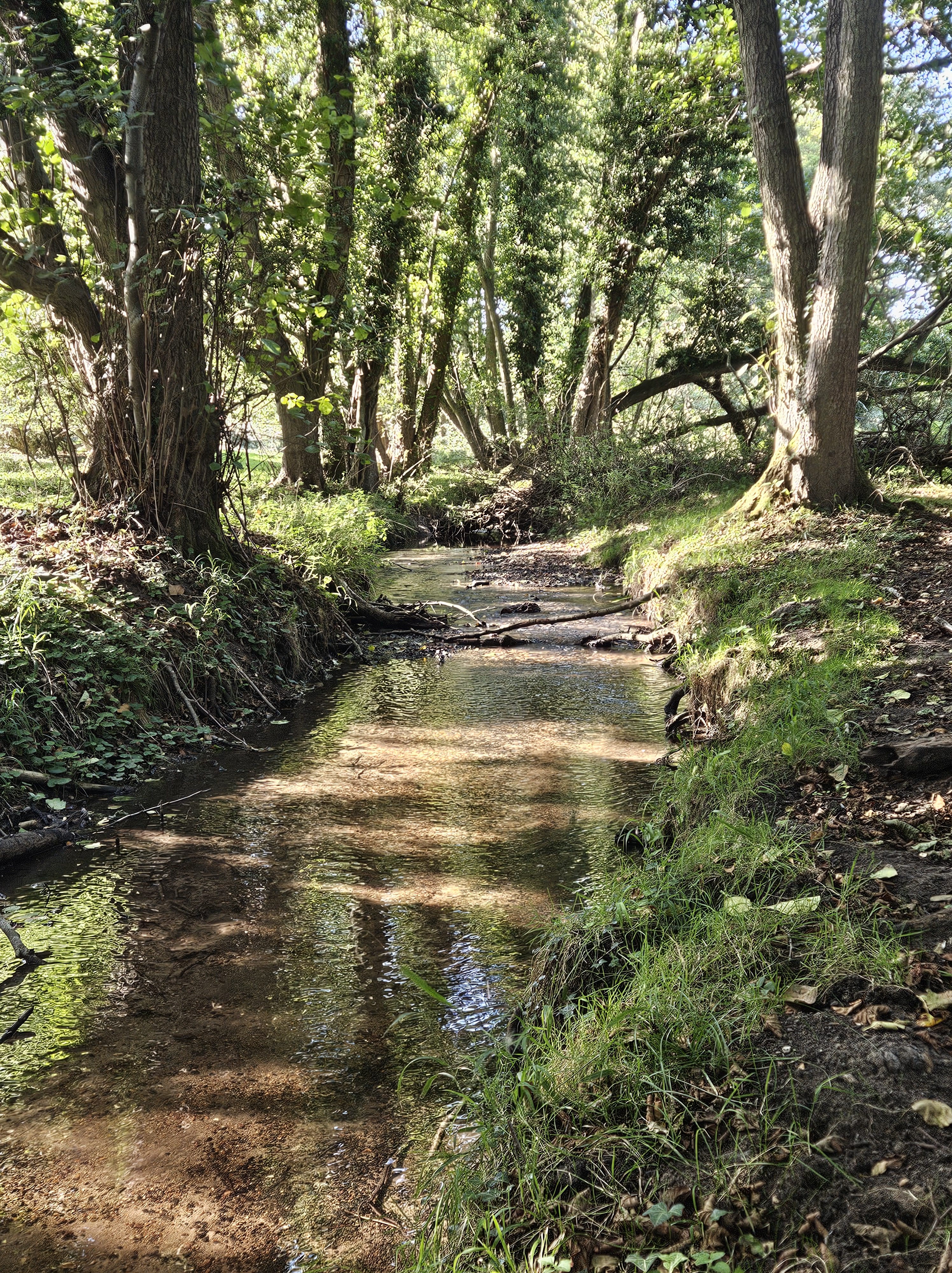
Rachael asked me ‘how did it survive?’. We were sat on a fallen tree beside a beck that moved swiftly over stones. Running water is not a noise I hear often in Norfolk, a county of low hills and quietly moving rivers. It is a sound I seek out when I can. Between Rachael and I were our flasks of tea and the biscuits I had bought on the way. Both of us were dressed in boots and work trousers, our untidy hair tidied loosely back, although Rachael’s is a shade lighter than mine, more strawberry blonde than my red-brown. As well as the biscuits, we also shared the ease of a long-established friendship.

Around us Flordon Common was so tangled it felt like a place that had rarely changed in a thousand or more years. The marshy ground had been lightly grazed by a herd of cattle that now slept beneath trees across the beck, sedges and reeds grew in tussocks. Willows and alders cast dappled shade around us and I knew that if I touched the water, it would be cold, despite the warmth of the afternoon. Like many Norfolk streams, this one is born from the deep bedrock of chalk beneath East Anglia and rises clear and icy, even in on a sunny autumn day.

I knew too what Rachael meant by her question. How did this land survive the enclosures of commons, the ploughs and the agricultural sprays, and the endless tidying up and homogenising of the Norfolk countryside? The ripping up of hedges and copses, the filling in of ponds and straightening of rivers into deep, unnatural drains. How did it manage to escape, so that the willows and alders grow tangled and wild, so that the summer orchids flower and the meandering stream are still here?

Art critic Lucy Lippard writes that all places are stories waiting to be unearthed. Flordon Common will have its story – a hunt through archives and old maps would reveal some of it, although much might not be written down. Sat on the fallen tree, I answered Rachael with a guess that this was once a part of a large village common, where cattle were grazed and firewood gathered. On our visit, and despite a summer of drought, the land was damp after recent rain; likely then it would once have been too hard to drain or to plough – the returns not worth the investment. Both of Racheal and I had parents who grew up in a Norfolk where horses were still used on the land; it feels so long ago, a time when effort and labour were measured differently from now. Being difficult gave this land a chance of survival.

Perhaps, too, it was left as common during the great waves of enclosure that swept Norfolk, and indeed the rest of Britain, from Tudor times until the early nineteenth century. Locals may have put up a fight to retain it. Too poor to employ lawyers, they may have refused to leave their mark on legal papers, damaged fences or whispered sedition in the pub. More likely, it was left as a place where a few villagers could carry on collecting wood and grazing stock – a crumb of land thrown to the poor as compensation for the common fields that were being fenced in for crops or for sheep. Helping those dispossessed by the loss of their commons was not only a matter of humanity or Christian charity. Many enclosures took place in the decades after the French Revolution and the land owners of Britain saw helping the poor as a way, quite literally, of keeping their heads. ‘Poors’ land, also known as ‘doles’ or ‘charity lands’ can be found across Norfolk still; some were leased out for money that was distributed to the poor of the parish, whilst others had rights for firewood or grazing granted to local households. Even now, some poors lands are overseen by local committees ruled by the local squire and the church.

When Rachael and I got up to leave, I scattered a few biscuit crumbs on the ground. It is an old habit from my youth, from the days when I lived out on the land, squatting among woods and hills threatened by road building. A little thank you to a place, an acknowledgement of its lives, both present and past. As we followed the stream back to the road I recalled, to myself, the words that George Eliot wrote at the end of Middlemarch, ‘the growing good of the world is partly dependent on unhistoric acts; and that things are not so ill with you and me as they might have been, is half owing to the number who lived faithfully a hidden life, and rest in unvisited tombs’. I said to Rachael that whatever actions people have taken to ensure Flordon Common could survive, I wanted them to know I was grateful.

A common land year, August

Between the stones and the sky

Writing in September, I’ve almost forgotten how my mid-August journey to Moscar Moor scared me. All through the heatwave of May and June and July, the clay soils of my home ground held on to a few drops moisture, helping the oak trees behind my house to keep their dark leaves despite the drought. Even after the hay was baled and removed, the common grew a weak but hopeful sheen of green. My journey took me through west Norfolk, out across the Lincolnshire Fens, over the hump of the Wold and down into the Trent Valley. The roadsides offered too little shade and too many trees were turning brown as if autumn had come early. The grass was the dry gold of sand, and I felt hounded by heat, unable to escape it. The almost lush trees and fields beside the rivers of the Peak District were a welcome relief at the end of my travels. The colours were deceptive however: wildfire warnings were posted on gateways, telling every visitor that the land was tinder-dry, vulnerable to a single spark amongst the heather and gorse.

Derbyshire is not mentioned in The Common Lands of England and Wales, written in 1963 by two of the most eminent geographers of their era – WG Hoskins and L Dudley-Stamp[1]. The book covers the character, wildlife and significant commons of every county in England and Wales; I’ve checked a few times, but Derbyshire is not there. At first, I thought that this could not be true, for the unfenced acres grazed by sheep, bracken and heather and gorse look like upland commons from Dartmoor and Bodmin to Cumbria and Wales. Stamp and Hoskins were right, however, and the Derbyshire hills are not commons any more. Instead, they are enclosed lands belonging to farms, or are rented for sheep grazing.

On the afternoon that I walked up Hordron Edge, the speckled grey and white face of an ewe and her lamb peeked warily from the bracken; her face was the colour of the sky. I was grateful for a day of clouds that made being outside before dusk more pleasant than it had been for weeks. This was my second walk on the ridge – the night before I’d headed up with friends to watch the Perseid meteor shower, the bright points of light and their fading tails falling amongst the shadows of hills and a wide sky of stars. Alone and in daylight now, I stood on the exposed rocks the top of the Edge, facing west and glimpsing the waters of Ladybower Reservoir between the hills. There should be a word in English for standing on a hilltop or ridge, for the sense of calm exhilaration, the impossible-to-deny urge to be still and quietly gaze at the view.

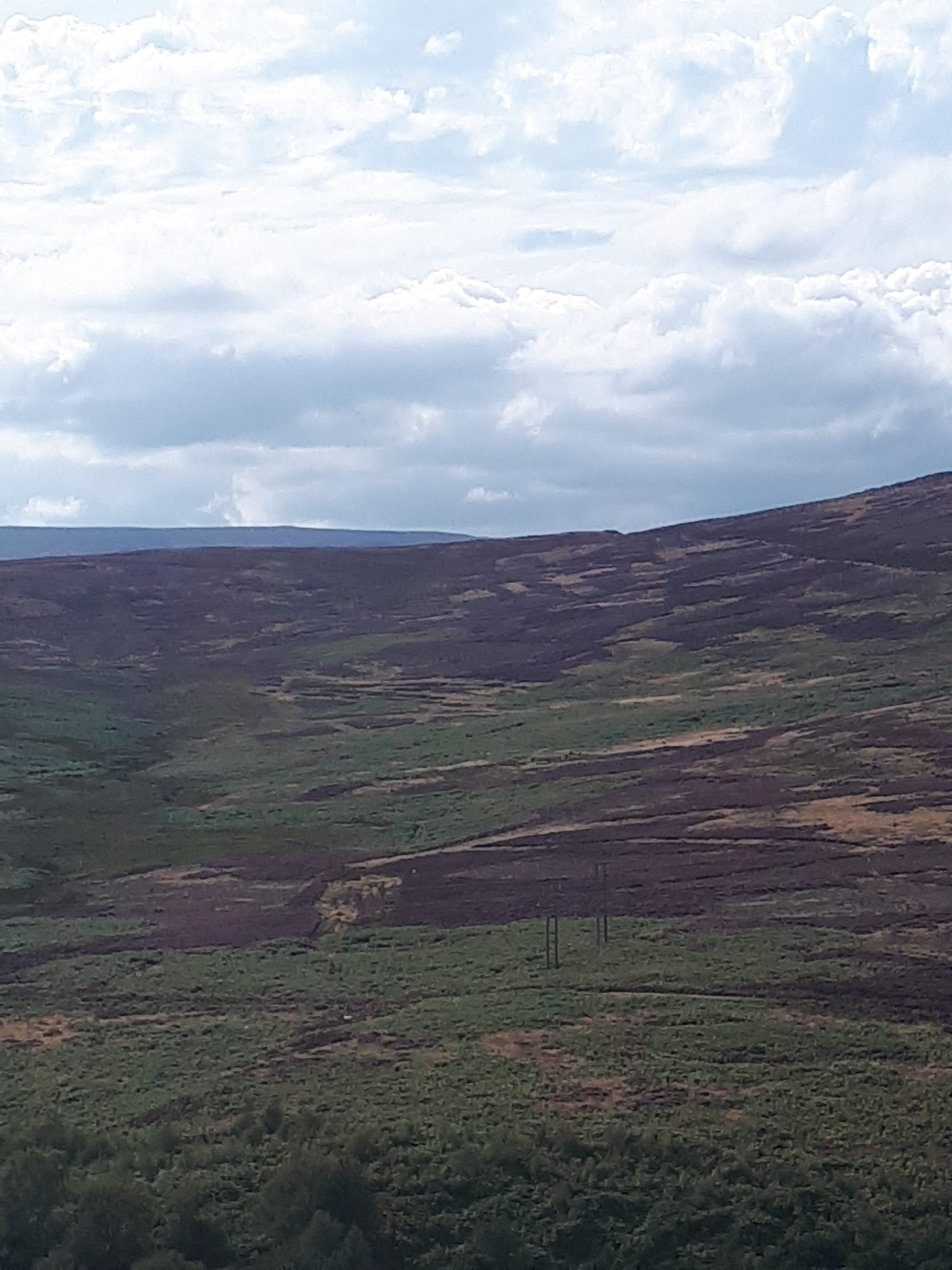
On the edge of the cliff, a single grouse scuttled into the bracken, head held high as if alarmed and a dark eye turned towards me. It was young bird, its characteristic red feathers only just emerging through the pale ones of its fledging. Watching it I recalled that this was the week of the ‘Glorious Twelfth’, the start of the grouse shooting season, and I wondered how much longer the little bird would survive. Like all red grouse it was dumpy, almost comical, and a reminder of another reason why the commons of the Derbyshire hills were enclosed. Grouse shooting has shaped this land as much as sheep grazing has, with many moors enclosed by Victorian land owners eager to bring their friends and their guns. Across Cutthroat Pass, north of my vantage point, was another legacy of grouse shooting, visible as a hillside with the green and almost black stripes and squares of heather burning. Here, over time, and on rotation, old heather had been burnt off to encourage the growth of new sprigs – the main food plant of grouse.

The patterned ground of moorland burning and grouse shoots also occurs on moorland commons across England. Over the past twenty years, I have sat on common land committees where both supporters and opponents of shooting and burning have been passionately vocal in their views. I have heard the supporters maintain that carefully controlled burns remove accumulations of dry, woody material that poses a wildfire risk. They pointed too at the income and employment that shooting brings to rural communities, and how moorland management for grouse also encourages birds like lapwings and curlews. When I first started attending meetings, the opponents spoke mainly about the shooting and poisoning of buzzards and red kites and hen harriers that will predate on grouse. Other arguments followed – how the draining of moors for shooting exacerbates wildfires, how adder populations plummet when grouse numbers are high, as the birds pick off the pencil-slim juvenile snakes, and, with increasing urgency, how some moorland management damages one of Europe’s greatest carbon sinks. When the peat is drained and then charred as the heather above it burns, it dries out and loses its ability to lock-in carbon, turning these habitats from carbon stores into carbon emitters.

The arguing has grown louder in recent years, with protests and legal challenges, highlighting opposition to moorland burning and management for grouse. There has also been legislation and new codes to limit the burns, as well as funding to re-wet the peat so that it can sequester carbon and be more resilient to wildfires. The recently burnt patches on the hill across the valley from Hordron Edge, however, were an indication that the arguments carry on – another of the many conflicts that surround Britain’s common land.

In the heat of August, after months of no rain, fire in this land was a terrifying thought. As I stood on the top of the Edge, the peat soils beneath my feet were dust-dry, as frightening as the desiccated land I had travelled through to get here. Behind me, the Bronze Age stone circle at the top of Hordron Edge was half-covered in tall heather and bracken. When I walked over to the ring of low stones, laying my hand on their lichen covered tops, I found a Brigid’s cross at its centre. It was woven from rushes, with a single feather, the grey-white of a pigeon laid across it, echoing the colours of the sky and the speckle-faced sheep. Both the cross and the feather were weighed down by a pebble. Maybe it was visiting pagans, or perhaps someone’s whim, nimble fingers weaving the green stems into an intricate shape that was once believed to bring blessings and protection. I touched the offering gently with my fingertips, whatever the intent, it brought me back to the moment and stilled the turning over of common land arguments in my mind. Sometimes it is enough to just watch the view, and to remember that people across millennia have heeded the call of high hills, acknowledging a place that stands between the stones and the sky.


[1] The Common Lands of England and Wales, Dudley Stamp, L & Hoskins, WG, New Naturalist, London 1963

Nant Glas

Leigh guided me out of the farmyard behind her mum’s house, through a rusting wrought iron gate, and onto a path not marked on any map. Leigh was dressed for her morning run, light-footed in trainers and with her long, dark hair gathered back from her face. I stomped after her in my boots. We’d left the house before my brother Jon, who is also Leigh’s partner, had woken up; above the trees that lined the narrow trail, the sky was the blue of an early summer morning, promising a warm day with barely a breeze. ‘I love this path’, said Leigh. It runs a short distance between two farms, but must, we thought, have been walked by generations of neighbours. Halfway along, we stopped for a moment on a bridge of a single plank across the Nant Glas stream: nant translates as ‘stream’, but glas in Welsh could mean blue or green or even silver. The running water looked dark and small below us and Leigh thought the levels were low for the time of year, adding that it had barely rained through the winter; ‘not like it used to’, she said.

After the stream, the path crossed a track that ran uphill to the common. Meeting people who grazed livestock on the common was the reason for our morning walk, but before we’d set out, I’d looked at the common on an OS map. It had told me that the track ended in sheepfolds – pens where the animals were once held for shearing, trimming feet or moving on somewhere else. The map showed the common as the pale beige of open access land, looped around with darker brown contour lines, cramped together to indicate slopes. There was evidence of centuries of land use too – prehistoric burial cairns, disused quarries and, marked by the gothic script that signifies antiquity, an old settlement high on the common. I had to remind myself that I was here to look at the common as it was now and not be distracted by its past.

Leigh led me across the track and into a farmyard, with orange baler twine twisted into a metal gate and a lightly rusting tractor parked among hay bales in a barn. The dusty smell of the hay mingled with sharp scents of diesel and the earthy aroma of cattle. At the farmhouse door, Leigh introduced me to Joe, before heading back to the track for her run. Joe, thin and bearded in his work-worn jeans, showed me through to the kitchen; the house reminded me of Leigh’s mother’s home, with low rooms of beams and dark wood, a modern extension on one side, and a sleek kitchen of straight lines at odds with the uneven, white painted stone walls.  

In the kitchen, I met Joe’s wife Pam, she was small and dark and spoke as if she tolerated little nonsense in her life. Neither of them, they told me, is Welsh. When I asked about their relationship with the common at the end of the track, there was a moment of silence. For a moment I wondered if this was normal for them, if they were quiet people who thought before answering a question, or if there was some awkwardness they were considering before voicing a reply. In the end, they admitted they had stopped keeping sheep on the hill, firstly, they said, there was so little money in sheep farming, with fleeces worth less than the cost of shearing and meat prices impacted by cheaper imports. Then, Pam continued, she worries about the health problems that can happen when flocks from different owners mingle on the common. She chooses her words carefully, treading softly around a disquiet that other farmers show less concern about the wellbeing of their animals than she does. ‘We’ve opted for cattle instead’, says Joe, Welsh Blacks that can cope with the weather, poor grazing and uneven ground. Even so, Pam works to supplement their income and it seems as if there is little return on the hours they spend tending their beasts.

When I left Pam and Joe, and headed back along the path across the Nant Glas, my head was still full of questions. As an ecologist, I have long been aware of the debates over sheep grazing on Britain’s upland commons; decades ago, friends of mine used to call them ‘woolly maggots’, devouring vegetation and stripping the hills of scrub to shelter birds. Sheep grazing also reduces plant diversity and leaves the ground exposed in heavy downpours, reducing a landscape’s resilience to flooding. Yet the annual cycles of shearing, lambing, and gathering together to move flocks on and off the commons are anchor points in the year of hill farming communities. Swapping from sheep to cattle, as Pam and Joe have done, is often better for the land, as it allows steep slopes to grow scrub or even woodland, and reduces the close-cropping of plants carried out by sheep. It also requires new skills, different farming methods and capital investments many hill farmers do not have.

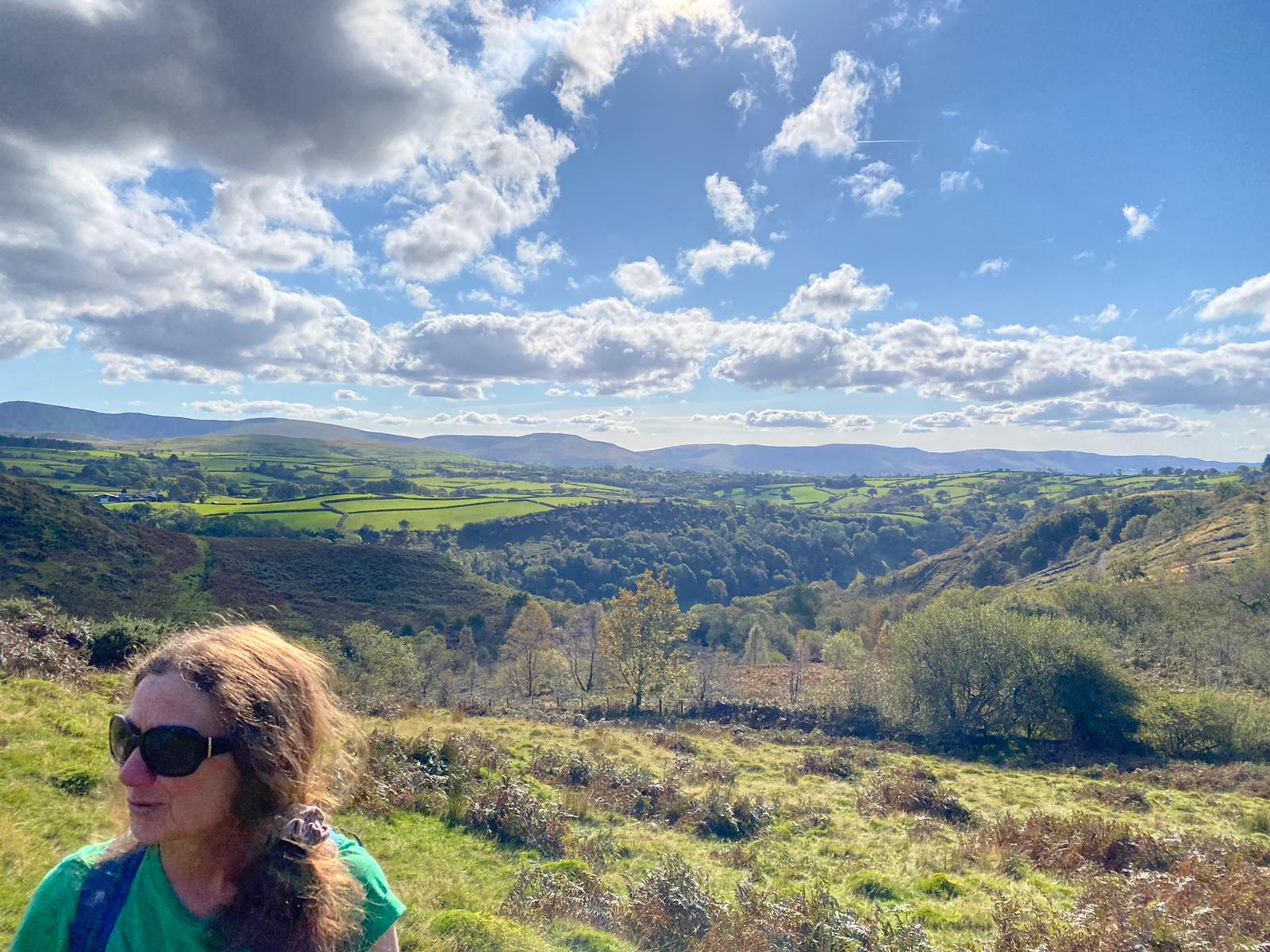
I was still mulling these thoughts over in the afternoon, when Jon and Leigh and I walked up to the summit of the common. My brother, who is six foot and blonde, scrambled among the rocks of the cairn at the top; in our youth we were both rebellious – me living on protest camps and he playing music at illegal raves. Now I am an ecologist and Jon is an archaeologist and his knowledge always gives me a deeper time history of the places we visit. I see medieval commons and later agricultural changes, whilst he spots Bronze Age field systems and Neolithic burial sites. Below us the land looked tightly grazed, with short grasses and bracken and no sign of trees. Leigh pointed out a criss-cross of shorter vegetation, where the grass and bracken had been cut in the autumn to create a break in case of wildfires. The summer has barely drawn breath, I thought, but wildfires have already burnt hilly commons to the north of the land above Nant Glas this year.

Mostly when I talk about commons, people want to dwell about the past, on long-ago enclosures, how they left British people with so little access to land and slowly cut off out connection to it. Yet, this hill, its short grass and dry ground is a reminder that some of our common lands are still here, and they are places where the climate and nature crises are happening in front of our eyes.

Myddfai Common, Bannau Brycheiniog

The Raven and the Coal Mine

Memories of a week spent squatting land scheduled to be Britain’s first new coal mine for decades. Edited edition first published by https://mckenzieriver.org

A solitary raven has flown over my tent every morning this week. Most days I have heard the prrr-ruk call before seeing the bird’s silhouette, with its fingered wings and wedge-shaped tail. Eastwards, behind it, I’ve watched the sun rise over the mountains of the Lake District, whilst to west the Solway Firth still holds on to darkness and a few fading stars. Below the raven, my green tent nestles on waste ground between a housing estate and red-brown rocks that tumble down the sea. This week I am one of maybe two hundred environmental activists squatting land where England’s newest coal mine for decades is planned. A selection of banners, reading ‘leave it in the ground’ and ‘no new fossil fuels’, hang from our marquees, from the outdoor kitchen and our portable, composting toilets.

To the Vikings who settled north-west England, ravens were the birds of Odin, the all-father of their gods. Odin had two of the coal-black birds as companions and called them Thought and Memory; he also gave one of his eyes in exchange for knowledge of the future, and was forever troubled by what he learnt. In the here and now, when I arrived at this field by the sea, I was warned not to eat the blackberries that grow here. Underneath us are the foundations of a chemical works once infamous for the waste it leached into the sea as it produced detergents, phosphates and sulphuric acid. On top of the factory footings are years of landfill, covered over with concrete and topsoil. The brambles look innocent enough, scrambling across the broken tarmac and cement, their fruit turning from red into purple in the late summer sun. But the plants can reach their roots deep down into whatever lies beneath us and draw up the long-buried toxins. Above ground, the tangled stems mingle with low bushes of goat willow, the thistle-like flowers of knapweed, drifts of white yarrow, purple selfheal, zig-zag clover, tiny yellow bird’s foot trefoil, feral sedums and garden mint that scents the air as I walk across the site. A comma butterfly, orange wings against the green plants, searches for nectar among the flowers; someone tells me there are adders here and at night I hear tawny owls calling across the derelict ground.

The land is supposed to be private, but the fencing has been ripped open or rusted into holes and the remains of gate hinges swing empty on their posts. Every day, local children cycle past on the tracks that cross the site. I am aware that we have landed in their space, pitching our tents on their common ground, where they explore the wild edges of their town and themselves. They are curious, occasionally insulting and dare each other to speak with us. ‘Why have you all got manky hair?’ asks a stocky lad in shorts and a blue football shirt. He has a point, I think, as we emerge from our sleeping bags in the morning and head to the kitchen to find tea. We look unbrushed and scruffy, wrapped in layers against the chill breeze from the sea. Despite the taunts, a couple of protesters helped the children to dismantle discarded pallets and to make ramps for their skateboards and bikes. This afternoon I bought a couple of boys a few slices of just-baked vegan cake from the kitchen. They eyed it nervously and then smiled, nodding with satisfaction when they recognised the familiar tastes of chocolate and sugar.

In the evenings, local men and occasionally women walk their dogs among the bushes. Those who stop to chat are friendly, but say that the nearby town of Whitehaven needs the five hundred or so jobs that the coal mine will bring. On the main street there are boarded up shops and, mounted on a plinth like a memorial, an old wheel from the Haig colliery tower. When it closed in 1986, three and a half thousand jobs were shut down with it. I tell the men I understand and that I grew up in mining communities in the English Midlands. As we talk I remember how my teenage mates were frequently stopped at police roadblocks during the 1984 to ‘85 Miners’ Strike and how fifty or more riot vans at a time would line up on our village street on their way to the picket lines. The men of my mum’s family had been miners, I say, with blue-black grit engrained in the scars on their hands. She spoke of ancestors killed in underground fires and the dark coal dust her Grampa coughed up in his old age. During the Strike, boxes of food and children’s clothing would be piled on our kitchen floor on the way to the Miner’s Welfare.

I left home a year later, returning to see poverty creeping into the villages and towns, shutting down the shops and changing the way people walked. Unemployment has a listless shuffle, mingled with a kicking rage. I know there is nostalgia in the memories that the men and I share; it is not just the jobs, but the lost sense of a shared experience, and pride in hard and difficult work that for nearly two hundred years powered the furnaces of the industrialised world. Our conversations end with agreements, usually as I bend to gently tug a dog’s soft ear – yes, there should have been investment into these communities decades ago and, yes again, the current government is a shambles. I am trying to build bridges with the community that we have set up camp in, so I don’t mention what I am thinking – in a time of rising temperatures and seas, with accelerating rates of extinction, our current worries might soon be completely eclipsed. Like Odin, my days are troubled by visions of the future.

One afternoon there is a presentation about the proposed pit. The speakers are in a white marquee and we sit around them on the ground. I pick at a ribwort plantain leaf. Normally I would tell other people about how this plant can help heal our skin and is better than dock leaves for stings or insect bites. Today I remind myself to wash my hands as soon as I can, just in case it too has pulled up poison from the earth. For a moment I wonder how we broke our relationship with a small, useful plant and all of the wild lives of this Earth, and I have to remember to concentrate on the details of the new pit. Permission to build it was granted just a few weeks before, although there is still a possible legal challenge. Someone says that most of the coal will be shipped overseas for making steel. European steel works, the speakers say, are moving to cleaner, lower-carbon methods of manufacture and see coking-coal as an old and dirty technology now. There is a long discussion on how extracting this coal will ruin Britain’s commitments on carbon reduction and how the site will be fully automated, with no men underground, just machines, boring away beneath the sea bed. The world has moved on since the Haig pit and those around my home village were closed. The old days of the rattling winding gear and the pit-head camaraderie will never come back.

When I left the marquee, a warm smell of spices drifted across the camp. The evening meal would be served soon and already people were gathering with bowls and spoons in their hands. I wandered off, looking across the low bushes, grassland and decaying tarmac towards the sea. In this moment, I felt a sudden sadness for this unkempt place, where the wildness is creeping in and local people walk or play. The speakers in the marquee had said that the toxic waste and soil below our feet would be excavated and taken somewhere (no one is sure where), to make room for the buildings, haulage roads and machines of the colliery. The willows, flowers and brambles would be rooted up, the bees and the butterflies, adders and tawny owls chased away by the noise and construction work, all inconsequential in the face of trade deals and global markets. It feels to me like a kind of madness has gripped those of my species who think that any of this makes sense.

Standing on the cliff above the sea, I listen to the kee-kee of jackdaws flying to their evening roost. I watch the glinting wings of goldfinches and the dip and rise of the murmuration of starlings that gathers here at dusk. I have spent some of the last thirty years of my life blockading bulldozers and squatting houses or trees in the path of road building, quarries or airports. Yet I still have no real answers to the seemingly impossible balance between livelihoods and the rising waters, rising temperatures and growing rates of extinction. Watching the settling birds, I give myself permission to admit this uncertainty and still be here, witnessing the land, speaking aloud the names of the bird’s foot trefoil and brambles, carder bees and comma, starlings, goldfinches and jackdaws. After three decades, saying the names of the wild, acknowledging their lives, feels like the only thing that I know. As I turn and walk back towards the tents, the nearby street lights flick on in a long line. In an hour or so a full moon will rise behind the mountains, a fire will be lit in the heart of the camp and a night of songs and stories will begin. In the last moment before sunset, I hear again the deep, slow call of ravens, the birds of memory and thought.