A common land year, June

The year tilts in the days and weeks that follow the summer solstice. I’ve noticed already how the season of growing and blossoming has tipped towards one of harvest. In the past week, I have filled my freezer with gooseberries and beans, and my hung drying herbs in my kitchen – rosemary, thyme and sage to flavour cooking, comfrey for making salves and mint for tea through the winter. On the common, tiny red berries are forming on the hawthorn bushes and soon there will be blackberries, rosehips, elderberries and sloes. If rain falls while the soil is still warm from the summer, the broad brown heads of parasol fungi will appear and, in the autumn, there will be gaggles of teenagers, hunting in the grass for magic mushrooms.

In her book on the social impacts of the enclosure of common land[i], JM Neeson writes of how women were often at the forefront of resistance to the landowners’ fences and ditches. In the period she writes about, 1700 to 1820, much of the dissent was by refusals to sign papers, pretending to be out when the surveyors arrived, and a range of similar foot-dragging obstructiveness. My favourite story in the book is that of an old woman who said she would sign away her rights when the oak trees she had planted reached maturity. The role of women in these quiet and stubborn acts of rebellion make sense. The use of the commons extended far beyond grazing and firewood and hay, further even than the cheeses that could be sold in local markets and geese fattened for selling for Christmas tide feasts. Women and children knew where bedstraws could be picked for stuffing into mattresses, or fleabane gathered for drying into a powder used to keep away biting parasites. On the commons there was yarrow and selfheal for wounds, gorse flowers for wine and the first flush of nettles for a welcome green food after winter.

Neeson’s research focuses on a few parishes in Northamptonshire, not far from where the poet John Clare grew up, and was gleaned from parish records and transcripts of court hearings. My instinct is that the same stories were playing out in other places all across Britain, although, as Neeson’s work shows, unearthing the histories of the rural working class is painstaking and slow. To the enclosers, the financial independence of the commoners was viewed as both insolent and objectionable. Tales were told of labourers turning down work when the wages offered were too low, confident that they could live on the resources of their commons alone and ill-inclined towards doing the lord of the manor’s work for so little return. The Board of Agriculture, founded to promote agricultural innovation in Georgian England, hoped that enclosure would annihilate that ‘nest and conservatory of idleness and misery, which is uniformly to be witnessed in the vicinity of all commons’.

Only three percent of England and Wales is now common land, but the spirit of independence lives on among the commoners that are left. I’ve felt it myself when someone objected to me keeping my pony on my common – I answered every phone call and email with a shrug. Let them complain, I said, my rights are my rights. In Britain’s uplands I’ve heard commoners wearied by park runs that upset their cattle, by people who drive too fast along unfenced roads where animals roam, and by the endless ways that their way of life struggles to fit into the constraints of modern agriculture. Disease testing, restrictions on the movements of livestock and stipulations on grazing levels or seasons can be hard to deliver when your animals free range across hundreds of acres of moorland or fell.

Earlier this year, the commoners of the New Forest, on England’s south coast, were recognised as a national minority by the Council of Europe. The status puts them on a par with the Cornish, the Ulster Scots or the Welsh. The recognition followed a campaign by the commoners, who wanted greater safeguards on commoning culture and better representation in land use decisions like forestry and development. I followed the story with interest – in 1996, I spent six months working as a ranger in the New Forest, mostly leading walks to show tourists bats and plants and nightjars, but sometimes cycling all day on bumpy tracks to check on the condition of cycle routes. One morning I observed the Verderers Court, which has dealt with offences against the Forest for nearly eight hundred years. I sat on a wooden pew at the back of a dark and timber-framed hall as the officials, known as Verderers and Agisters, gathered. Long ago these officers of the Court would have spoken about threats to the oak trees planted for ship-building and damage to fences around the plantations. Today the concerns are a mix of the old and the modern – the condition of grazing stock, the breaching of byelaws, who was grazing what animals where, illegal enclosures, dog attacks on cattle, ponies or sheep, collisions between free-roaming animals and cars, and the need for road signs. Common land, I realised that day, is much more than history, and the conflicts surrounding it rumble on.

The continued recognition of commoning as a way of life and the inclusion of commoners in decision-making are things that I can celebrate. Yet, the political divisions of the times we are living make me wary of discussions around identity; it feels too easy to let our allegiances become weapons and to be used to exclude or attack those who are not like ourselves. Identity is a slippery object, hard to hold and to truly define – I’ve known the common where I live all my life, but it was a place of refuge for my Polish grandparents, the place where they settled after World War 2, when the westward expansion of the Soviet Union meant that they could not return home. When I walk periphery of my common in the long evenings of mid-summer, I often think of how, like most of us living in Britain, I am part of this place, but with a heritage that stems from somewhere else. Usually, on my rambles, there are bats overhead, their quick movements no more than a flicker on the edge of my vision, sometimes an owl calls in a nearby wood and white moths rise from the long grass. Every common in Britain has its stories, both human and wild, and listening to them teaches about both the present and the past.

Parasol mushrooms on a Norfolk common


[i] Commoners: common right, enclosure and social change in England 1700-1820, Neeson, JM, Cambridge 1993
A Common Land Year, February

February Filldyke

My neighbour’s sheep escaped again this morning. I spotted them as I walked out of my gate – a small, tight flock grazing around one of the black and white ponies that I keep on the common. I was carrying a bucket of food and the little filly lifted her head when she heard my call, whinnying in reply. There was little other sound, no bird song or wind and only a whisper of rain; the still, damp air deadening the traffic noise from a nearby road. For a moment, I felt caught out of time, stranded briefly in a scene from medieval England, with just the low clouds and animals, the bare trees and short winter grass.

I texted my neighbour, telling her where her sheep were. A few centuries ago, allowing animals to stray onto the common, or grazing more animals than one’s entitlement allowed, or even putting livestock on at the wrong time of year, would have been a serious matter. If the transgressions continued, a quiet word between villagers would have escalated to a visit from the reeve or the hayward – official positions that monitored the use of common lands. Further breaches could have led to the matter being raised in the manorial court, where the lord of the manor exercised jurisdiction over his tenants and issued fines against offenders. The resources provided on common land were never a free for all, but apportioned across right holders and tightly managed. Today, beneath a sky the colour of pale fleece, I helped my neighbour herd her stray animals back into their field and we pulled wire across the gap they had pushed through.

In my childhood, in the 1970’s, traces of medieval commoning still continued in this border land between Norfolk and Suffolk. Several households in the village where I now live kept goats, flocks of geese or hens, and the occasional pony or cow on the common. Meat and milk and eggs supplemented meagre incomes earned from working on farms or in the local mill, but commoning was also a way of life. It involved rising in the morning to feed and care for the animals, standing whilst a whiskery nose nuzzled at a pocket, searching for treats, passing a hand across warm flanks and checking animals by torchlight on dark winter nights. For a couple of decades, the numbers of people using local commons this way were swelled by those who moved here seeking the good life. Disciples of John Seymours’ ‘Complete Guide to Self-Sufficiency’ moved to South Norfolk or North Suffolk in the 1970s and made use of the commons beyond their organic vegetable plots. Writer Roger Deakin lived beside a common a few miles from me and was part of the bohemian community that sprung up either side of the river Waveney. They had a dedicated newspaper, the Waveney Clarion, and held summer festivals of music, storytelling and crafts that intentionally evoked the fayres held on the commons of feudal England.

Over the past two years, I have visited dozens of British commons as research for my book, ‘Common Place’. Yet I found only one or two other people who, like me, are not farmers, but use their common as a source of firewood and grazing, working the land the in the way of the long-ago commoners. Sometimes I feel I am among the last of a breed whose origins are older than the Norman Conquest. Almost all of the commons I have visited, from England’s lowlands to the bare and sheep-shorn commons of Britain’s hills, were grazed by commercial livestock farmers or as part of nature conservation efforts. At Greenham Common, near Newbury in Berkshire, a representative of the local Wildlife Trust, who manage the common, told me that most of the cattle on the land are part of large farming businesses now, often leasing or borrowing rights from local commoners. He said that it was hard to know, sometimes, who owned certain cows, or how many had been loosed onto the wide grassland and heath of the common. No wonder, I thought, that the common lands of old had their wardens and courts – commons have a slippery history.

Greenham Common has slid out the public eye in recent decades, but in the 1980s it was a totem of a bleak decade. Several times my mum left our home in the Midlands and travelled to join demonstrations at the women’s peace camp on the edge of the common. The camp had grown up in response to a new generation of nuclear weapons, housed at the American airbase that had been built there in World War Two. The missiles were part of Cold War hostilities with the USSR and located at Greenham as part of a strategy where each side ramped up their weaponry and threatened annihilation. It was known as Mutually Assured Destruction and the acronym speaks for itself.

A decade after my mum’s trips to Greenham, I lived on the other side of Newbury for most of a year, protesting against the town’s bypass. My memory of that time is of always feeling tired, of rising at dawn to block vehicles that carried chainsaw crews or security guards into the woods along the route of the road, of building walkways and treehouses high up in the branches, of clinging to them as yet another bailiff tried to pull us out, of arrests and court and the sound of two hundred year old oaks crashing to the ground, one after another. The trauma and fatigue of those months left my memory in fragments, but also brought me back to my grandmother’s cottage in rural Norfolk. It was empty at the time and seemed a good place to rest for a while. I didn’t plan to still be here, thirty winters later, helping herd sheep on a February morning.

Unlike the reeves and the haywards of old, I am not worried about my neighbour’s sheep eating the grass on the common. My only concern is for dogs, for the main use of the common now is dog walking and people view the open space as a place to let their pets run free – enjoyable for the dogs, but less so for sheep. The grass itself is plentiful and has kept growing all through this mild winter; this is the norm now, when there is barely a full week of frost in a winter and snow is a rarity. February is, however, living up to its old name of ‘Filldyke’ this year, both on the common, with its hollows and ponds, and in ditches and fields that surround it. Once or twice a week now I have to move the ponies in their temporary fence, avoiding the wettest parts of the common.

Keeping animals on this land has given me a deep understanding of the hollows and the dry ground where the gorse bushes grow, of what plants edge the ponds in the spring and where to find shelter from the east winds of winter. Yet I don’t ‘own’ this place any more than the dog walkers do; it no more ‘belongs’ to me than it does to those who ride their bikes along the rough tracks, who build lean-to dens in the little wood, who camp here in summer or leave memorials to their loved ones below the trees. The other commoners I’ve met on my travels, even those with large flocks of cattle or sheep, have talked about the same connection with their commons, one that is built not on ownership, but on family history, on rights to use the land and a familiarity with all of the lives that live there. Today, walking back home with an empty bucket in my hand, I heard a song thrush warming his voice up for spring, watched the last of the starlings leave their roost in the reeds of a pond and spotted the neat hoofprint of a roe deer, left overnight in the mud. Each of them made me aware, once again, of how many of us value the quiet space of Britain’s common land.

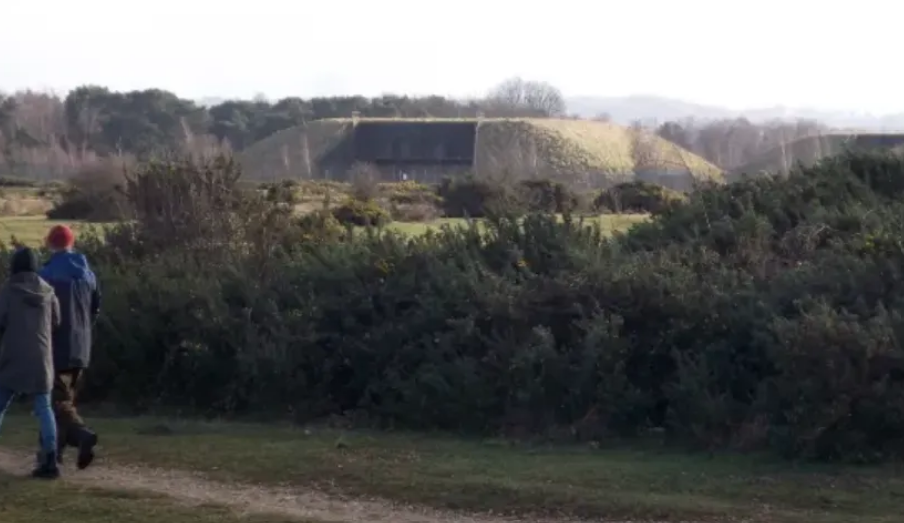
Silo, Greenham Common, Helen Baczkowska