February Filldyke
My neighbour’s sheep escaped again this morning. I spotted them as I walked out of my gate – a small, tight flock grazing around one of the black and white ponies that I keep on the common. I was carrying a bucket of food and the little filly lifted her head when she heard my call, whinnying in reply. There was little other sound, no bird song or wind and only a whisper of rain; the still, damp air deadening the traffic noise from a nearby road. For a moment, I felt caught out of time, stranded briefly in a scene from medieval England, with just the low clouds and animals, the bare trees and short winter grass.
I texted my neighbour, telling her where her sheep were. A few centuries ago, allowing animals to stray onto the common, or grazing more animals than one’s entitlement allowed, or even putting livestock on at the wrong time of year, would have been a serious matter. If the transgressions continued, a quiet word between villagers would have escalated to a visit from the reeve or the hayward – official positions that monitored the use of common lands. Further breaches could have led to the matter being raised in the manorial court, where the lord of the manor exercised jurisdiction over his tenants and issued fines against offenders. The resources provided on common land were never a free for all, but apportioned across right holders and tightly managed. Today, beneath a sky the colour of pale fleece, I helped my neighbour herd her stray animals back into their field and we pulled wire across the gap they had pushed through.
In my childhood, in the 1970’s, traces of medieval commoning still continued in this border land between Norfolk and Suffolk. Several households in the village where I now live kept goats, flocks of geese or hens, and the occasional pony or cow on the common. Meat and milk and eggs supplemented meagre incomes earned from working on farms or in the local mill, but commoning was also a way of life. It involved rising in the morning to feed and care for the animals, standing whilst a whiskery nose nuzzled at a pocket, searching for treats, passing a hand across warm flanks and checking animals by torchlight on dark winter nights. For a couple of decades, the numbers of people using local commons this way were swelled by those who moved here seeking the good life. Disciples of John Seymours’ ‘Complete Guide to Self-Sufficiency’ moved to South Norfolk or North Suffolk in the 1970s and made use of the commons beyond their organic vegetable plots. Writer Roger Deakin lived beside a common a few miles from me and was part of the bohemian community that sprung up either side of the river Waveney. They had a dedicated newspaper, the Waveney Clarion, and held summer festivals of music, storytelling and crafts that intentionally evoked the fayres held on the commons of feudal England.
Over the past two years, I have visited dozens of British commons as research for my book, ‘Common Place’. Yet I found only one or two other people who, like me, are not farmers, but use their common as a source of firewood and grazing, working the land the in the way of the long-ago commoners. Sometimes I feel I am among the last of a breed whose origins are older than the Norman Conquest. Almost all of the commons I have visited, from England’s lowlands to the bare and sheep-shorn commons of Britain’s hills, were grazed by commercial livestock farmers or as part of nature conservation efforts. At Greenham Common, near Newbury in Berkshire, a representative of the local Wildlife Trust, who manage the common, told me that most of the cattle on the land are part of large farming businesses now, often leasing or borrowing rights from local commoners. He said that it was hard to know, sometimes, who owned certain cows, or how many had been loosed onto the wide grassland and heath of the common. No wonder, I thought, that the common lands of old had their wardens and courts – commons have a slippery history.
Greenham Common has slid out the public eye in recent decades, but in the 1980s it was a totem of a bleak decade. Several times my mum left our home in the Midlands and travelled to join demonstrations at the women’s peace camp on the edge of the common. The camp had grown up in response to a new generation of nuclear weapons, housed at the American airbase that had been built there in World War Two. The missiles were part of Cold War hostilities with the USSR and located at Greenham as part of a strategy where each side ramped up their weaponry and threatened annihilation. It was known as Mutually Assured Destruction and the acronym speaks for itself.
A decade after my mum’s trips to Greenham, I lived on the other side of Newbury for most of a year, protesting against the town’s bypass. My memory of that time is of always feeling tired, of rising at dawn to block vehicles that carried chainsaw crews or security guards into the woods along the route of the road, of building walkways and treehouses high up in the branches, of clinging to them as yet another bailiff tried to pull us out, of arrests and court and the sound of two hundred year old oaks crashing to the ground, one after another. The trauma and fatigue of those months left my memory in fragments, but also brought me back to my grandmother’s cottage in rural Norfolk. It was empty at the time and seemed a good place to rest for a while. I didn’t plan to still be here, thirty winters later, helping herd sheep on a February morning.
Unlike the reeves and the haywards of old, I am not worried about my neighbour’s sheep eating the grass on the common. My only concern is for dogs, for the main use of the common now is dog walking and people view the open space as a place to let their pets run free – enjoyable for the dogs, but less so for sheep. The grass itself is plentiful and has kept growing all through this mild winter; this is the norm now, when there is barely a full week of frost in a winter and snow is a rarity. February is, however, living up to its old name of ‘Filldyke’ this year, both on the common, with its hollows and ponds, and in ditches and fields that surround it. Once or twice a week now I have to move the ponies in their temporary fence, avoiding the wettest parts of the common.
Keeping animals on this land has given me a deep understanding of the hollows and the dry ground where the gorse bushes grow, of what plants edge the ponds in the spring and where to find shelter from the east winds of winter. Yet I don’t ‘own’ this place any more than the dog walkers do; it no more ‘belongs’ to me than it does to those who ride their bikes along the rough tracks, who build lean-to dens in the little wood, who camp here in summer or leave memorials to their loved ones below the trees. The other commoners I’ve met on my travels, even those with large flocks of cattle or sheep, have talked about the same connection with their commons, one that is built not on ownership, but on family history, on rights to use the land and a familiarity with all of the lives that live there. Today, walking back home with an empty bucket in my hand, I heard a song thrush warming his voice up for spring, watched the last of the starlings leave their roost in the reeds of a pond and spotted the neat hoofprint of a roe deer, left overnight in the mud. Each of them made me aware, once again, of how many of us value the quiet space of Britain’s common land.
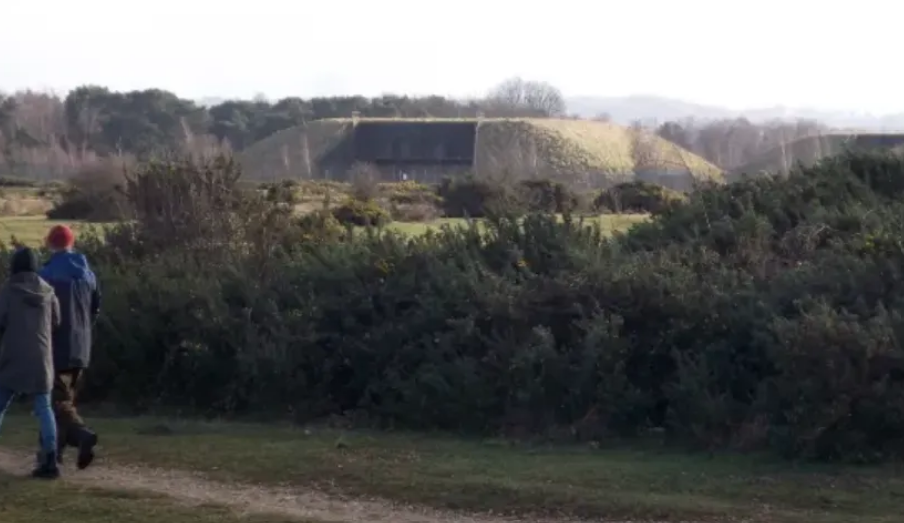
Silo, Greenham Common, Helen Baczkowska

