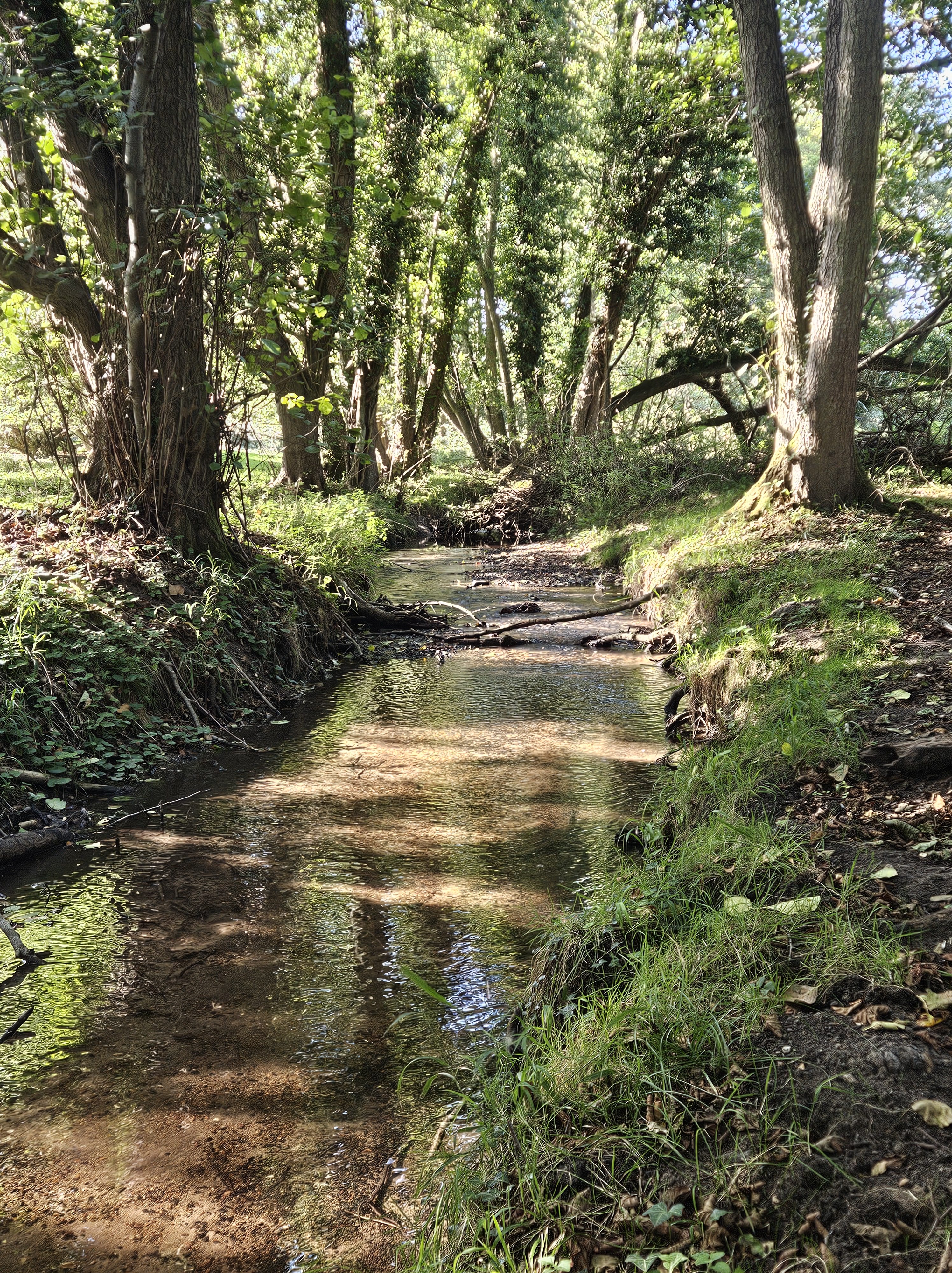
Flordon Common
Rachael asked me ‘how did it survive?’. We were sat on a fallen tree beside a beck that moved swiftly over stones. Running water is not a noise I hear often in Norfolk, a county of low hills and quietly moving rivers. It is a sound I seek out when I can. Between Rachael and I were our flasks of tea and the biscuits I had bought on the way. Both of us were dressed in boots and work trousers, our untidy hair tidied loosely back, although Rachael’s is a shade lighter than mine, more strawberry blonde than my red-brown. As well as the biscuits, we also shared the ease of a long-established friendship.
Around us Flordon Common was so tangled it felt like a place that had rarely changed in a thousand or more years. The marshy ground had been lightly grazed by a herd of cattle that now slept beneath trees across the beck, sedges and reeds grew in tussocks. Willows and alders cast dappled shade around us and I knew that if I touched the water, it would be cold, despite the warmth of the afternoon. Like many Norfolk streams, this one is born from the deep bedrock of chalk beneath East Anglia and rises clear and icy, even in on a sunny autumn day.
I knew too what Rachael meant by her question. How did this land survive the enclosures of commons, the ploughs and the agricultural sprays, and the endless tidying up and homogenising of the Norfolk countryside? The ripping up of hedges and copses, the filling in of ponds and straightening of rivers into deep, unnatural drains. How did it manage to escape, so that the willows and alders grow tangled and wild, so that the summer orchids flower and the meandering stream are still here?
Art critic Lucy Lippard writes that all places are stories waiting to be unearthed. Flordon Common will have its story – a hunt through archives and old maps would reveal some of it, although much might not be written down. Sat on the fallen tree, I answered Rachael with a guess that this was once a part of a large village common, where cattle were grazed and firewood gathered. On our visit, and despite a summer of drought, the land was damp after recent rain; likely then it would once have been too hard to drain or to plough – the returns not worth the investment. Both of Racheal and I had parents who grew up in a Norfolk where horses were still used on the land; it feels so long ago, a time when effort and labour were measured differently from now. Being difficult gave this land a chance of survival.
Perhaps, too, it was left as common during the great waves of enclosure that swept Norfolk, and indeed the rest of Britain, from Tudor times until the early nineteenth century. Locals may have put up a fight to retain it. Too poor to employ lawyers, they may have refused to leave their mark on legal papers, damaged fences or whispered sedition in the pub. More likely, it was left as a place where a few villagers could carry on collecting wood and grazing stock – a crumb of land thrown to the poor as compensation for the common fields that were being fenced in for crops or for sheep. Helping those dispossessed by the loss of their commons was not only a matter of humanity or Christian charity. Many enclosures took place in the decades after the French Revolution and the land owners of Britain saw helping the poor as a way, quite literally, of keeping their heads. ‘Poors’ land, also known as ‘doles’ or ‘charity lands’ can be found across Norfolk still; some were leased out for money that was distributed to the poor of the parish, whilst others had rights for firewood or grazing granted to local households. Even now, some poors lands are overseen by local committees ruled by the local squire and the church.
When Rachael and I got up to leave, I scattered a few biscuit crumbs on the ground. It is an old habit from my youth, from the days when I lived out on the land, squatting among woods and hills threatened by road building. A little thank you to a place, an acknowledgement of its lives, both present and past. As we followed the stream back to the road I recalled, to myself, the words that George Eliot wrote at the end of Middlemarch, ‘the growing good of the world is partly dependent on unhistoric acts; and that things are not so ill with you and me as they might have been, is half owing to the number who lived faithfully a hidden life, and rest in unvisited tombs’. I said to Rachael that whatever actions people have taken to ensure Flordon Common could survive, I wanted them to know I was grateful.